Johannes Lodewijk Dulcken (1735 – † between August 31, 1795 and December 27, 1799)
Johannes Lodewijk Dulcken (1735 – † between August 31, 1795 and December 27, 1799)

Research
Henk Poelarends en Hans Meijer
Introduction He was described as quick-tempered and quarrelsome, but now that extensive archival research has been carried out for the first time, that image has been completely overturned. Johannes Lodewijk Dulcken appears to have been a strong personality, an important link between the brilliant harpsichord maker Johan Daniel Dulcken (father) and the equally brilliant pianoforte maker Johannes Lodewijk Dulcken (son), with his Hasselt period (1761-1776) was of great significance for the further development of the harpsichord into the pianoforte.
Maastricht
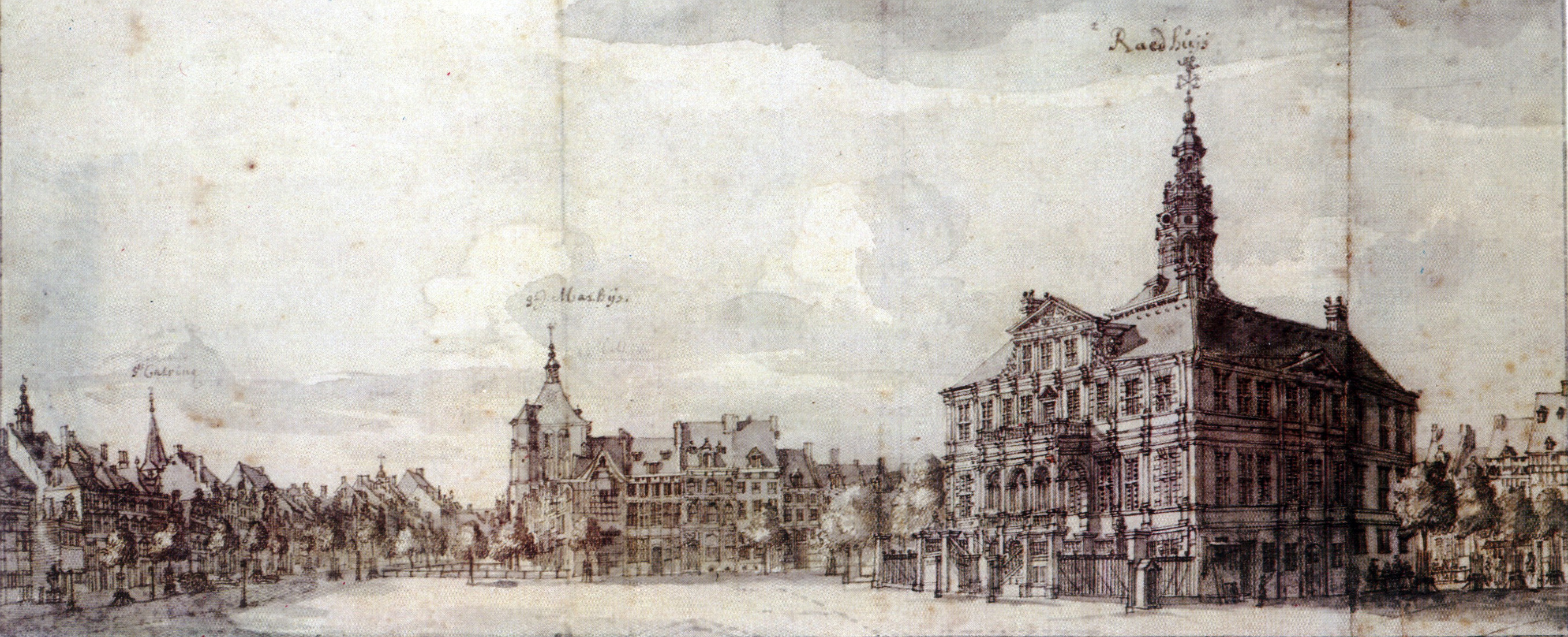
Maastricht, the Netherlands. View of the Markt (market square) and town hall. Drawing attributed to Jan de Beijer, ca 1740, in the collection of the Museum Boymans Van Beuningen, Rotterdam.
Youth
Johannes Lodewijk Dulcken was baptised on 15 April 1735 in St. Janskerk in Maastricht as the eldest son of Johannes Daniël Dulcken and Susanna Maria Knopffell. His father was a harpsichord maker and his mother ran a grocery shop (grutterij). The young family had financial problems and could no longer pay their loans and debts. Around the turn of the year 1737/38, his parents left their house on the Munt, “Het Gulde Cruijs”, and moved to Antwerp, where his father set up a workshop in Hopland. Louis was three years old at the time. As a child, he attended the Reformed Municipal Latin School in Breda.
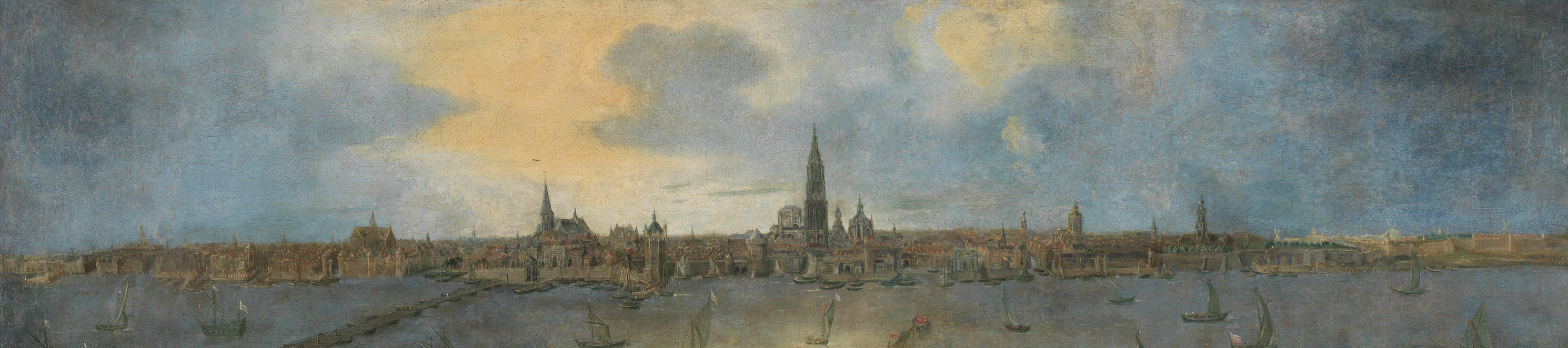
Johannes Lodewijk (nicknamed Louis) and his brother Joannes, seven years his junior, then received a thorough education from their father in Antwerp. Not only did they learn how to build harpsichords in the Ruckers tradition, but their father Dulcken also developed harpsichords with a unique tone colour and even better construction. In 1755, at the age of nineteen, Louis left to strike out on his own. One of his first commissions was the restoration of an organ in the Brabant town of De Leur. His task there was to restore and clean the organ.After completing his work in De Leur, he left for Amsterdam, where he was registered as a member of the Reformed Church in Amsterdam in March 1755.
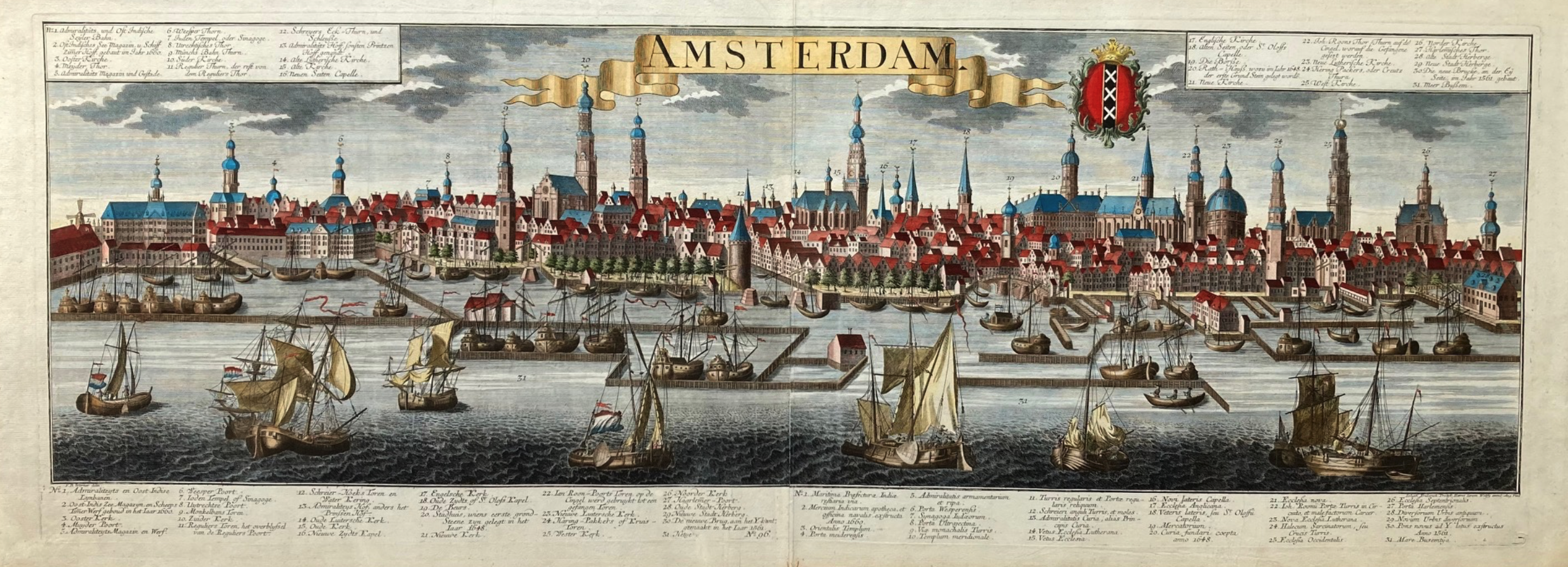
Just as he decided to leave Amsterdam and settle in Kleve, he met Catharina Koning. Catrina Kooningh was born on 23 January 1732 in Amsterdam and was the daughter of Ferdinand Kooningh, born in Osnabrugge, and Alida Buijs. Louis decided to stay in Amsterdam to set up a business there. The young couple married on 7 May 1756. Louis's father had to give his consent because he was still a minor.
Amsterdam
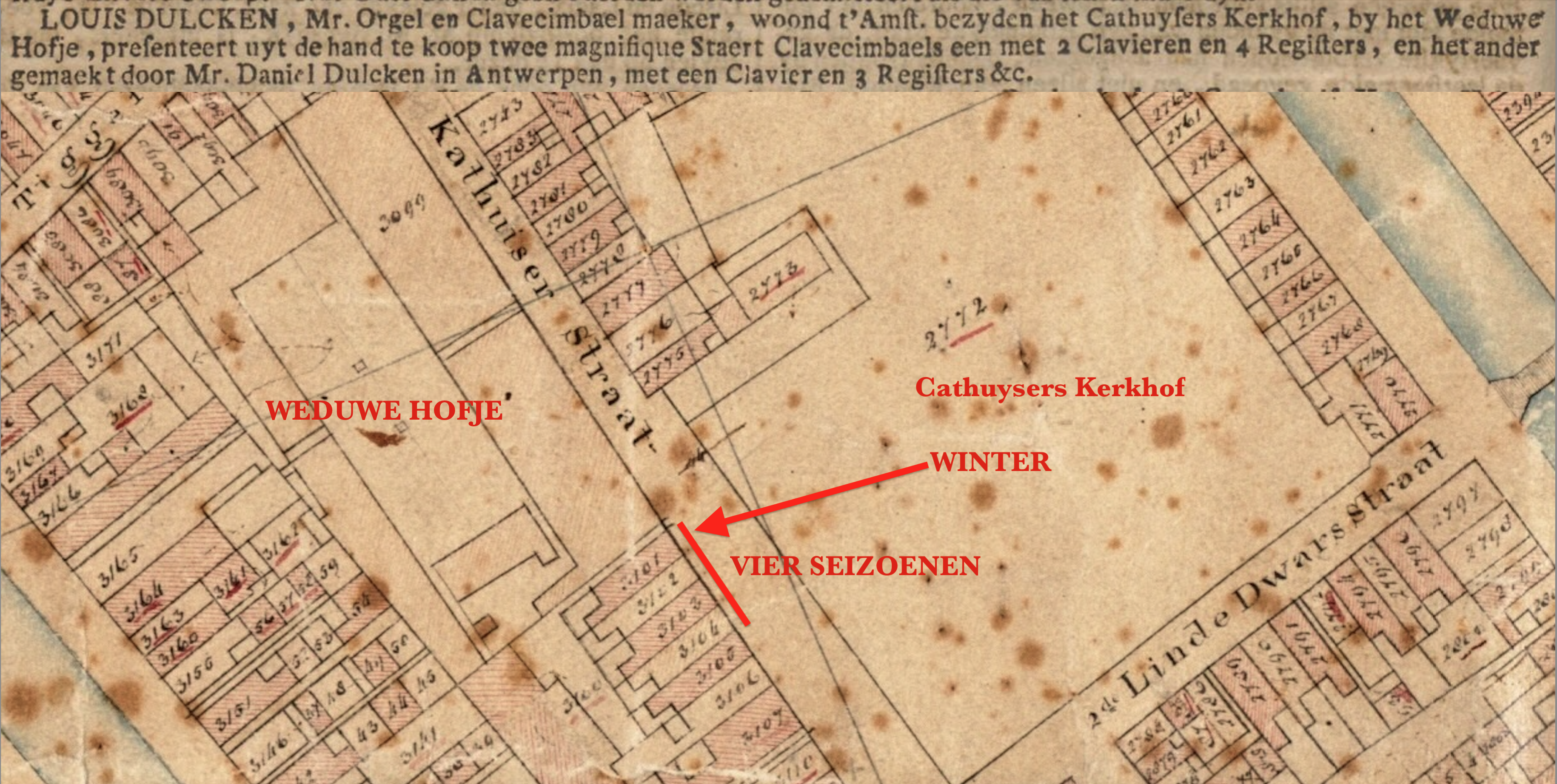
Louis Dulcken establishes a successful business in Amsterdam. The family lives south of the Cathuysers Kerkhof, near the Weduwe Hofje, and Dulcken sells his instruments from there. His first advertisement appears in the Amsterdam Courant on 18 May 1756. He presents himself as Mr Louis Dulcken, organ builder, and offers a “Stert Clavecimbael”, an authentic Hans Ruckers. Three months later, he presents himself as Master Organ and Harpsichord Builder. These advertisements show that he also specialised in building small and large organs and that he also sold hundred-year-old Ruckers. On Tuesday 7 September 1756, he offered a Stert harpsichord by Mr. Daniël Dulcken in Antwerp with a keyboard and three registers. In order to increase production, he employs one or more assistants. He follows the tradition developed by his father in the construction of his harpsichords, which also include features of the famous Ruckers. In the construction of his organs, he constantly makes improvements and embellishments. When his father dies on 11 April 1757, he supports his mother in Antwerp. On 5 May 1757he offered for sale a “superbe (excellent) Koninglyk Cabinet Orgel, welker gelijke hier nooit gezien is, een Capitale Cabinet Orgel 8 voet present, 4 voet Octaaff, 7 en 1 half register”. This organ was probably sold to merchant Jacob de Clerq (1710-1777), Keizersgracht 187, where it was used as a house organ. In 1818, it was sold to the Reformed Church in Jutphaas, where it continued to serve as a Dulcken organ until 1972. Louis continued to innovate. In April 1759, he advertised "een magnificq nieuwerwets Cabinet-Orgel, zynde zeer comodieus gemaakt met uithaalend Clavier en voorzien van de voornaamste Registers &c". Dulcken also made very small organs, known as desk organs. It is believed that he was one of the first organ builders in Amsterdam to master this art and attract attention with it.
Hasselt
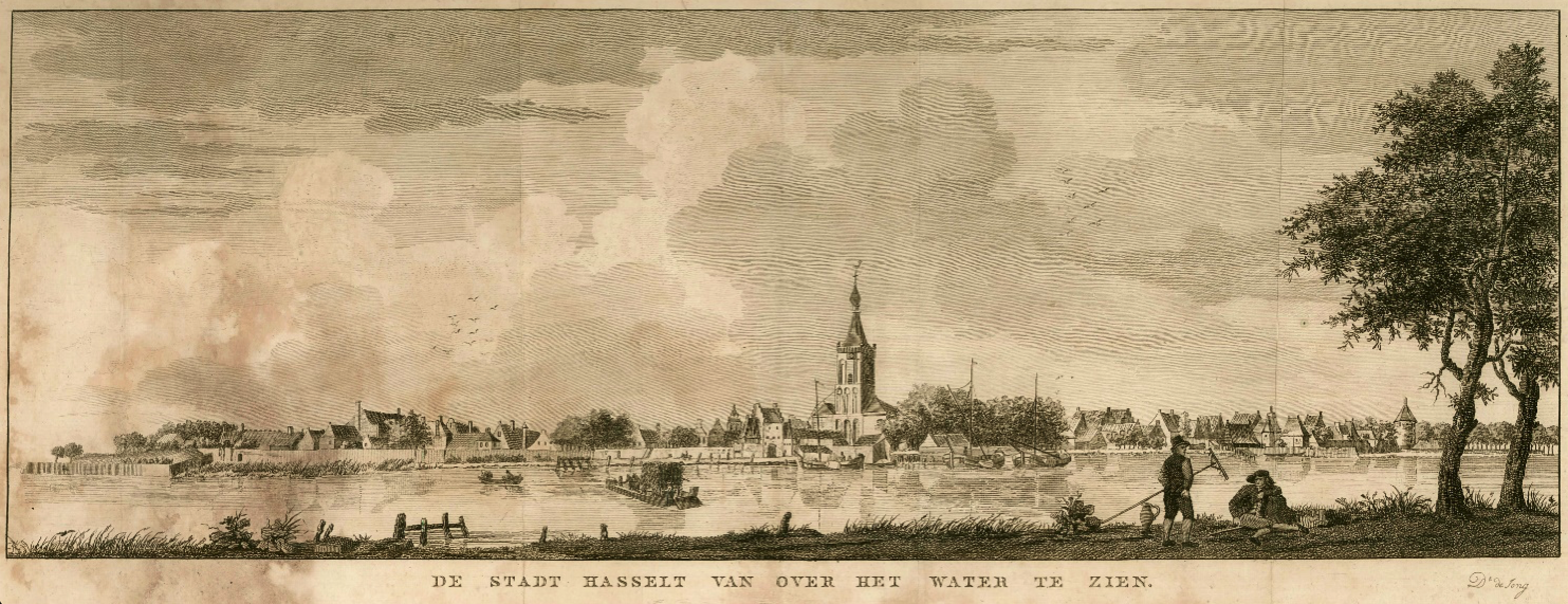
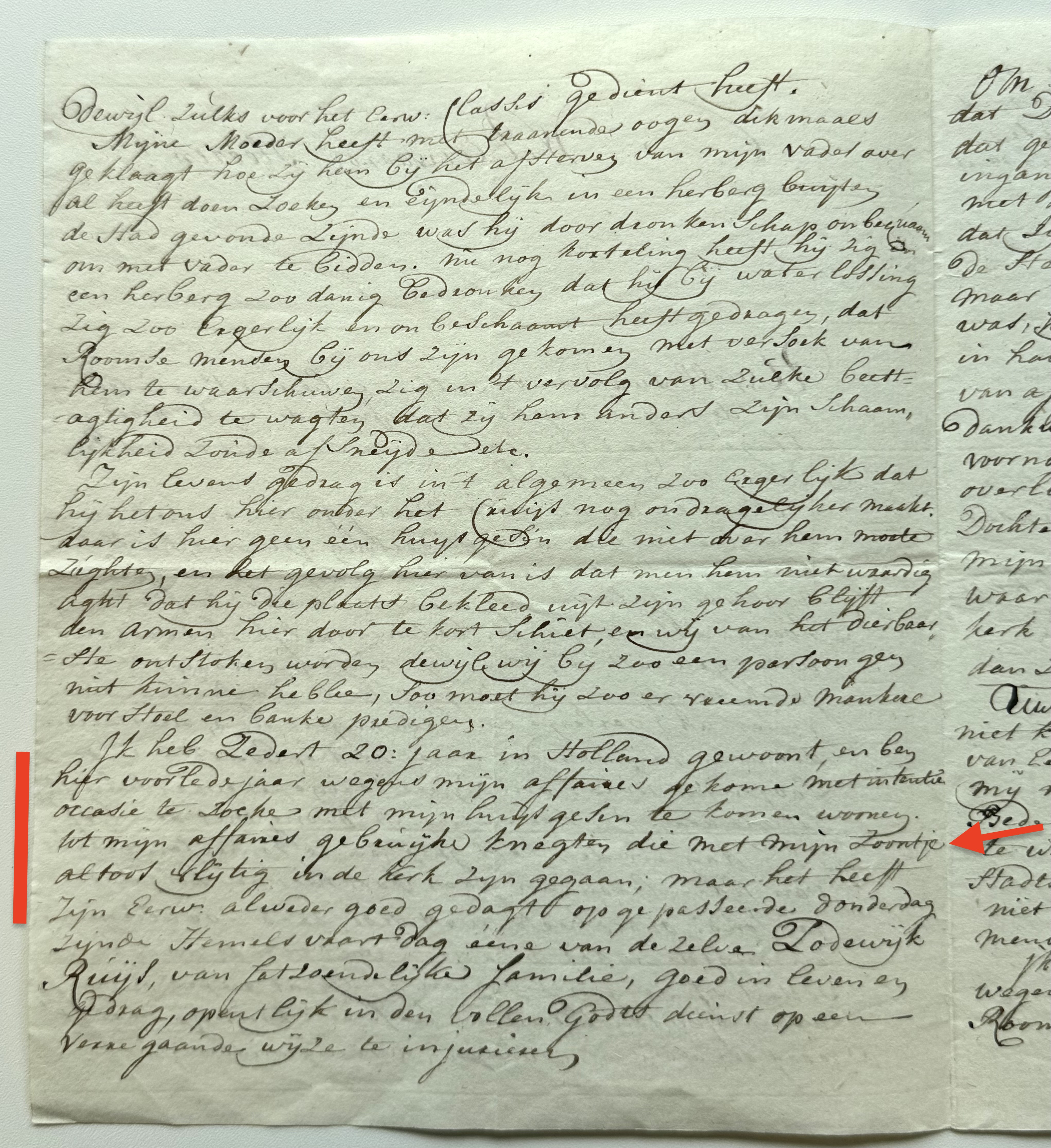
In the winter of 1762 Louis leaves with his wife and three small children, crosses the Zuiderzee and settles in Hasselt (Overijssel). The Dulcken family moved into a stately mansion in Hasselt on the corner of Nieuwstraat and Regenboogsteeg. He rented the property from Hendrik van Hecht, a merchant from Amsterdam. (The building was captured in a painting by Cornelis Springer in 1863.) Later, he bought a workshop on Hofstraat. In Hasselt, Louis was addressed as Mr Dulcken. The young family brought three small children with them to Hasselt: Susanna Maria, just five years old, Alida, four years old, and Jan Lodewijk, a few months old. A year later, Johan Daniël Dulcken was born and baptised on Sunday 13 May 1763 in the Reformed Church, a hundred metres away. The little boy, named after his famous grandfather, died a few months later. On 22 July 1764, Johan Daniël was baptised, followed by Johannes Ferdinandus on 16 March 1766. He sold the harpsichords made by him and his servants throughout the Northern Netherlands, from Middelburg to Groningen. In 1766, he took his instruments to Leeuwarden. There, on 5 April 1766, he was announced as Master Organ and Harpsichord Maker from Hasselt and offered a magnificent three-register harpsichord of his own making for sale. Dulcken, according to the newspaper, had already sold well over a hundred of these instruments in the Netherlands, and they were used in most of the major concerts. The harpsichord was particularly strong and pleasant in tone. In 1767, he repaired an organ in Wolvega.
Problems
Louis gets into debt. He borrows money, cannot pay for supplies and the servants demand their wages in arrears. He gets into arguments with his neighbours, with an innkeeper and with the magistrate. He becomes the victim of physical violence and malicious slander. His harpsichords are confiscated and he is even imprisoned. The archives of Old Hasselt contain a large number of documents relating to lawsuits brought against him by others and by Louis against others. In the lawsuits, he is assisted by Verwalter Hoogschout A.U. Grevensteijn. Meanwhile, he continues to make and sell harpsichords. On 13 January 1768, a son is born, whom they name Ferdinandus. Unfortunately, he also dies a month later. In december 1768 wordt Johannes geboren en op de tweede kerstdag in de Gereformeerde Kerk gedoopt. In the spring of 1769, Susanna Maria Dulcken, Louis's mother, came to live with her son in Hasselt. She was the widow of Johan Daniël Dulcken. On 7 August, she was registered as a member of the Reformed Church. Louis applied for citizenship of Hasselt, which was rejected by the Magistrate on 18 October 1770. In August 1772, Catharina was born and baptised in the Reformed Church on 19 August. In the course of 1771/1772, Louis's problems pile up, but he is well known to a large part of the population. In order to gain influence within the Magistrate, he writes a request to Prince William V prior to the mayoral election of 1772. The request states that, due to his achievements and good behaviour, he deserves to become mayor. The document was signed by members of the influential skippers' guild and other prominent citizens. The magistrate reacted furiously and, after questioning, Louis was imprisoned “under the stairs” for two weeks on 7 January 1772. he request was rejected. He applied to the church council for membership of the Reformed Church, but this was also rejected. The legal proceedings against him and by him dragged on, partly because Louis was spending more and more time outside the city. He focused increasingly on the Southern Netherlands for the sale of his harpsichords.
🇬🇧
Amok on St. Paul's Day: How Harpsichord Maker Louis Dulcken Defied the Ruling Elite of Hasselt
🇩🇪
🇳🇱
Amok op St.-Pauli: Hoe klavecimbelbouwer Louis Dulcken de machtselite van Hasselt tartte
Back to Antwerp
On 18 August 1772, he applied to the Magistrate for a certificate of good conduct, after which he settled in Antwerp in the autumn of 1772. His eldest son Johannes Lodewijk (Louis jr.) went with him. His wife, mother and other children remained in Hasselt. The workshop in Hasselt was closed and his three servants, Johan Gerlach Lauch (who had been in his service for 10 years), Johann Lodewijk Reusch (who had been in his service for 6 years) and Jacob Schnell (who had been in training for six years) seized several harpsichords on 16 April due to unpaid wages. Despite these unpaid wages, Reusch and Schnell accompany him to Antwerp and continue to work for their master there. On 10 September 1773, he advertises himself in the Gazette as: “Jean Louis Dulcken, (eldest son of the late Daniël Dulcken), master organ and harpsichord maker, currently in Antwerp, with the intention of settling there in due course”. Dulcken experimented with the construction of the pianoforte in Hasselt and devoted himself to this in Antwerp from 1774 onwards. In the Gazette of 6 July 1775, he stated: ”dat by alhier heeft doen brengen twee Clavecin-Bellen, te weten een Steirt-Stuk en een Forte piano van zyn werk, zynde eene nieuwe Uytvindinge, dewyl men ongemerkt en zonder in commoditeyt den thoon van de zelve kan diminueëren en casseeren,” This made him one of the co-inventors of the pianoforte and marked an important step in the further development of the piano. In Antwerp, he submitted a request to the city council to be granted the same rights as his father, namely the ability to export his harpsichords free of charge. The city council rejected this request for various reasons. He became a member of the Reformed Church, the Olijfberg, where his father had once been an elder. This led to a dispute between him and Rev. Diepelius. In order to discredit Louis Dulcken, the minister, driven into a corner by accusations against him, asked the Magistrate of Hasselt about Louis' behaviour in that city. On 7 May 1776, an important meeting of aldermen and councillors takes place in Hasselt Town Hall. At this meeting, the “final settlement” of two important lawsuits in which Dulcken was involved takes place. Dulcken is vindicated in both cases. With this, the family bids a final farewell to Hasselt. Their house and workshop are sold at auction. On 3 November 1776, Dulcken and his wife were in Amsterdam, where they collected a copy of their marriage certificate from the church in Sloterdijk. This was a document that would enable them to start a new life as a family in Antwerp. On 13 March 1777, he was in Ghent, where he sold a harpsichord that his father had made in Antwerp in 1740. Father Louis was a good teacher to his eldest son. The Dulckens, father and son, were probably very successful in Antwerp. So successful, in fact, that they were noticed by Karl Theodor von der Pfalz, the Elector of Bavaria.
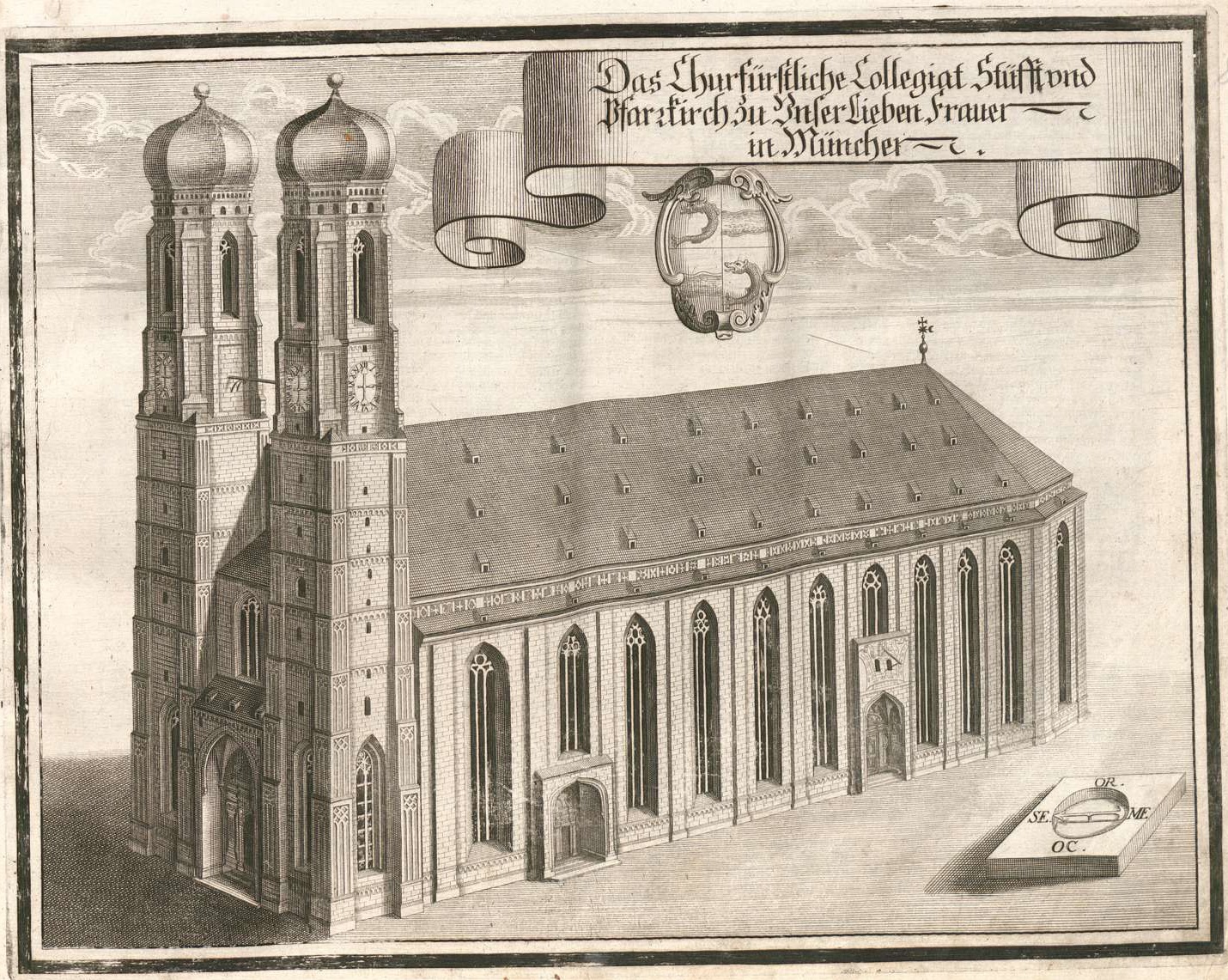
In 1779, he asked Johannes Lodewijk Jr. to accompany him to Munich, where he became Johann Peter Milchmeyer's assistant. He was only 18 years old at the time. So young and already recognised as a brilliant harpsichord maker. Two years later, he became the “City Harpsichord Maker”.
Paris
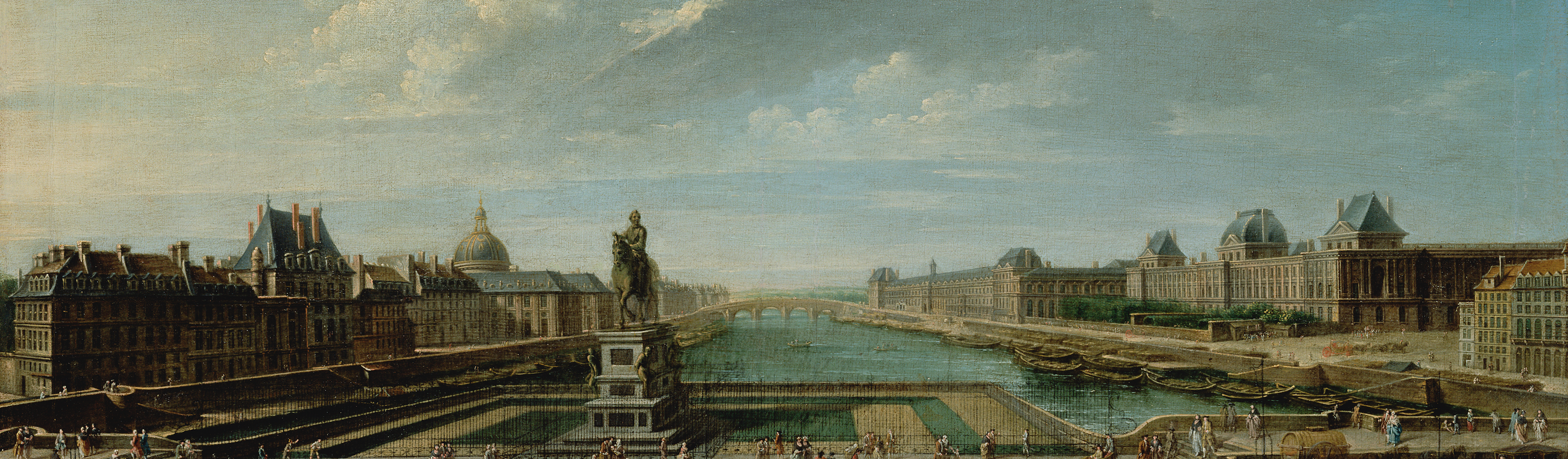
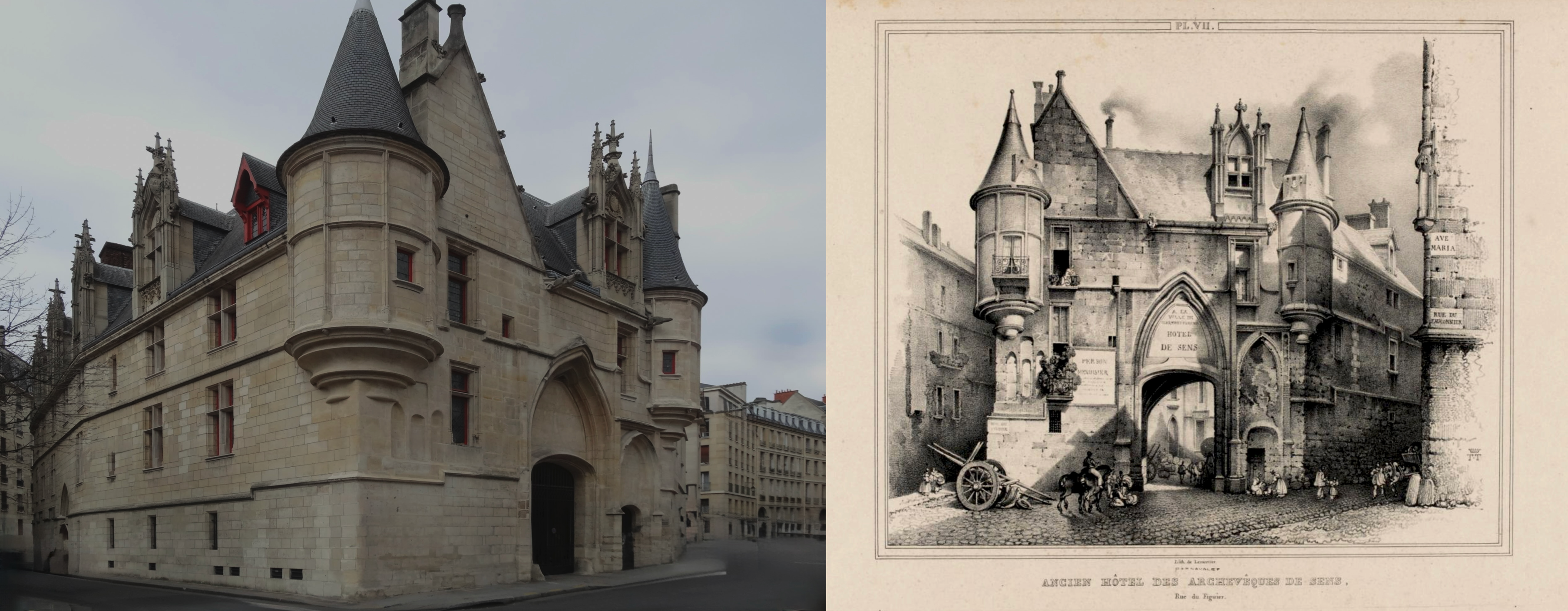
Louis and Catharina did not remain in Antwerp. He probably settled in Paris at the end of 1777. Johann Jacob Schnell went with him to Paris and developed into a renowned instrument maker. Louis was registered as a member of the Corporation of Tabletiers, on 17 February 1780, and in 1783 he lived in the Rue Vieille du Temple and from 1788 in the Rue Mauconseil. He was involved in making and selling harpsichords. The penultimate trace of him is his registration in 1791 at the address Quai de Gesver. He probably died and was buried in Paris. The idea that he moved to Munich is incorrect and stems from a case of mistaken identity with his son, who had been living and working there since 1779. "Information from the marriage certificate dated 27 December 1799 in Munich, of his son Johannes Lodewijk II: Ludovicus Dülken, Electoral Court instrument maker, non-Catholic, legitimate son of Ludovicus Dülken, Royal French instrument maker, and Anna, his wife, both deceased. This would imply that Johannes Lodewijk was a royal instrument maker during the reign of King Louis XVI. Marie Antoinette played the harpsichord and the fortepiano.
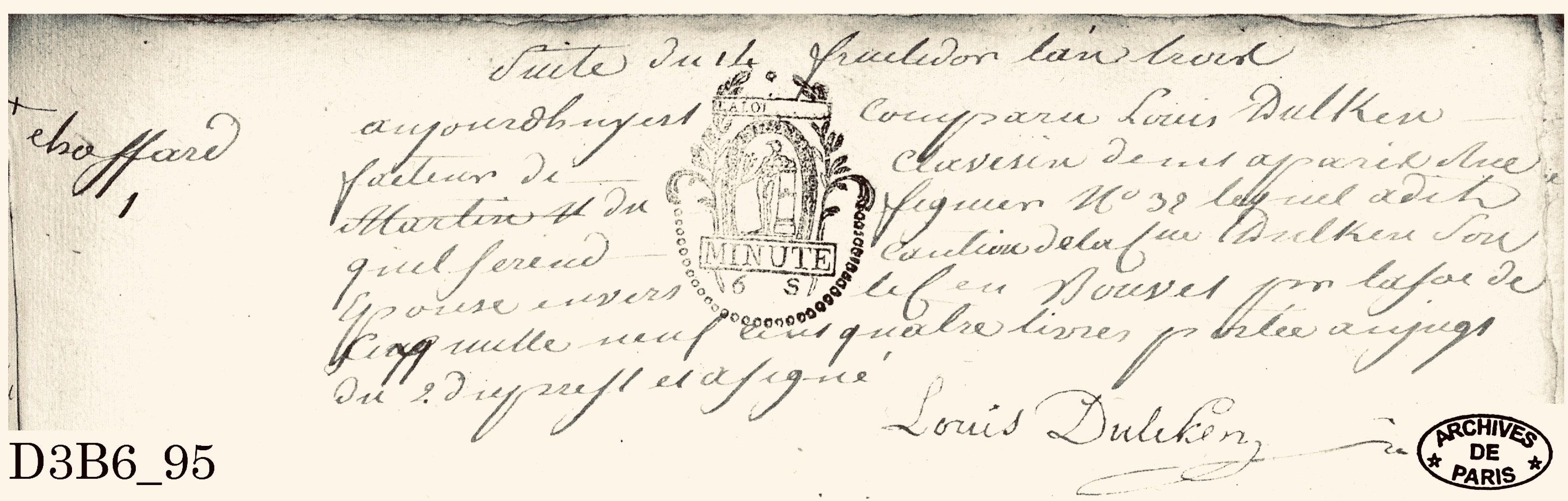
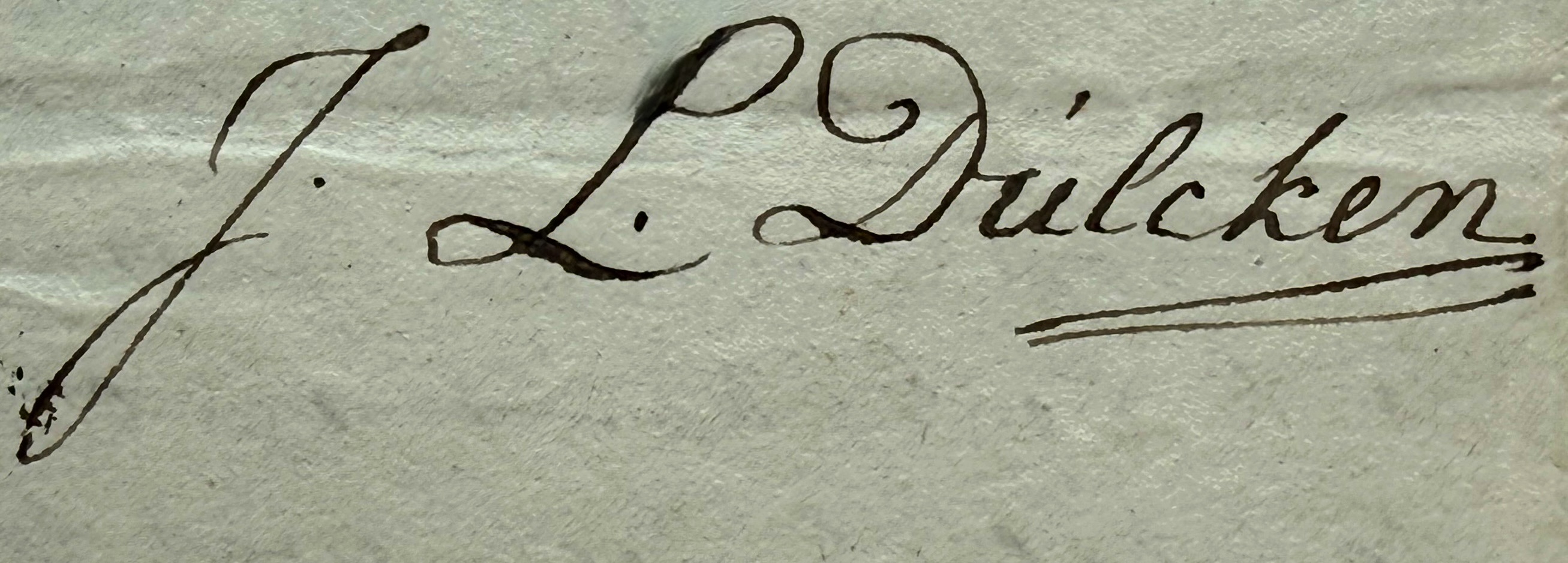
Suite du 14 fructidor l’an trois aujourd'hui est comparu Louis Dulken facteur de clavesin [demt = demeurant?] rue Martin et du figuier N°32 lequel a dit qu'il [se rend] caution de la [citoyenne] Dulken son épouse envers le [citoyen] Bouvet [pour la somme] de cinq mille neuf cens quatre livres portée [au jugement?] du 2 [du présent?] et a signé Louis Dulcken transcriptie Richard Etiévant English translation:
Continuation of the 14th Fructidor, Year III Today appeared Louis Dulken, harpsichord maker, residing at No. 32, rue Martin et du Figuier, who stated that he stands surety for Citizen Dulken, his wife, toward Citizen Bouvet for the sum of five thousand nine hundred and four livres, as set forth in the judgment of the 2nd of the current [month], and has signed: Louis Dulcken
Vervolg op 14 fructidor, jaar III Vandaag verscheen Louis Dulken, klavecimbelbouwer, woonachtig op nr. 32, rue Martin et du Figuier, die verklaarde dat hij zich borg stelt voor burger Dulken, zijn echtgenote, jegens burger Bouvet voor een bedrag van vijfduizend negenhonderdvier livres, zoals vastgelegd in het vonnis van 2 van de lopende [maand], en heeft ondertekend: Louis Dulcken
The date 14 Fructidor Year III in the French Republican Calendar corresponds exactly to Monday, August 31, 1795.
Huwelijk 27 December 1799 Jan Lodewijk (Louis)Dülken x Sophia Lebrun R.K. huwelijk München (Archive des Erzbistums München und Freising, Seelsorgeeinheiten, Pfarreien und Kirchenstiftungen, CB301, München-Zu Unserer Lieben Frau 1561-1937, Pfarramtsverwaltung, M9313, Trauungen 1798-1806, Bild 35,
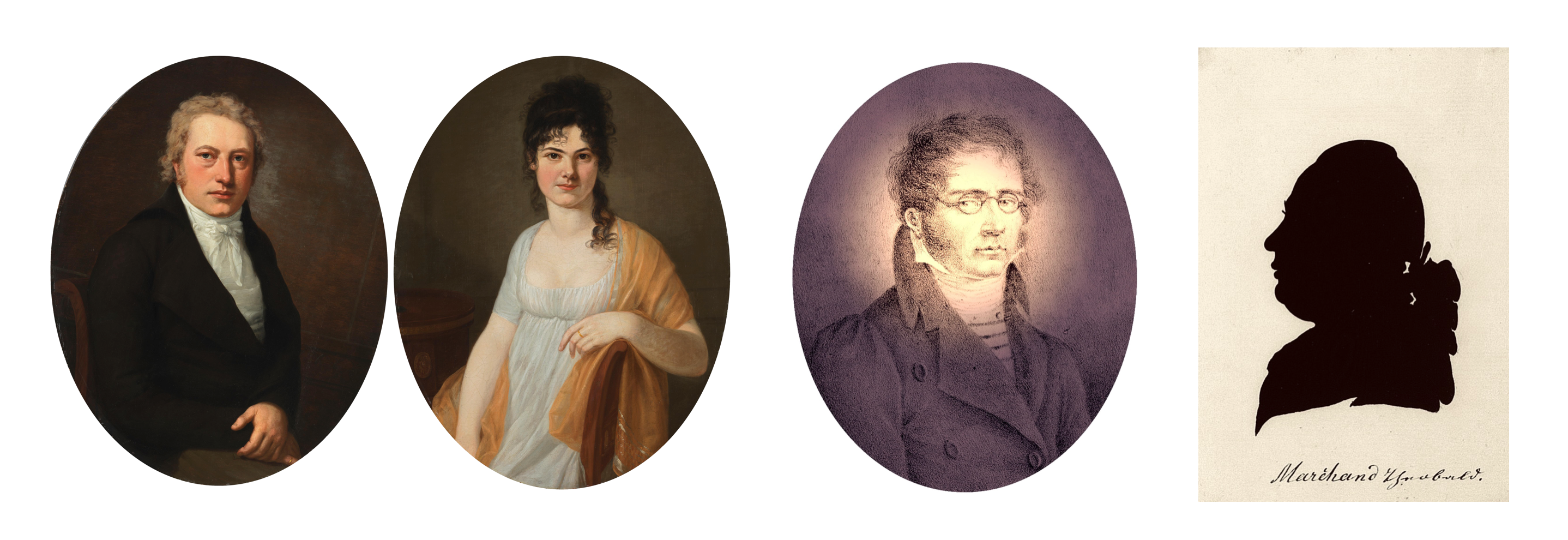
"Nomina Sponsoru[m] Dies Mensis Decembris An[n]o 1799
Dülken, seu 27. Ludovicus Dülken churf[ürstlicher] Hof-Instrumen[ten]
Dälken macher, acatholicus, des Ludovicus
dessen Dülken k[öniglich] französischen Instrumenten
Revalidation machers, dann Anna dessen Eheweib
m[a]t[ri]m[on]ii ____ beiden seelig, ehlicher Sohn, mit
Sophia Lebrun, des Ludovicus
x Lebrun churf[ürstlichen] Hofmusikus, dann
Lebrun Francisca dessen Eheweib seelig, ehelichen
Tochter. Testes: Theobald Marschand
churf[ürstlicher] Theater-Director, Franz
Danzi c[h]u[r]f[ürs]t[licher] Kapelmeister, tempore
vetito cum dispensatione denuntiationu[m]".
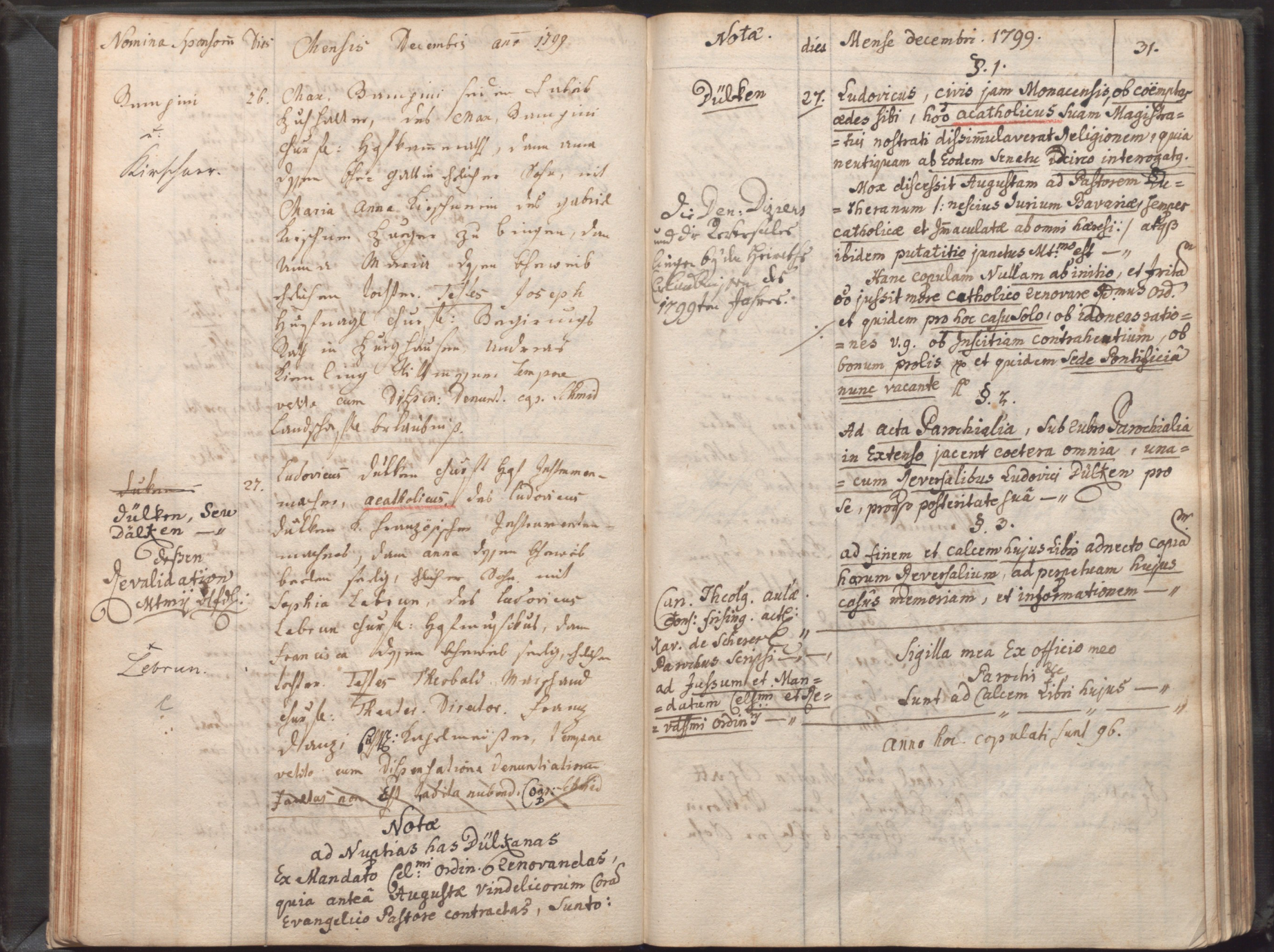
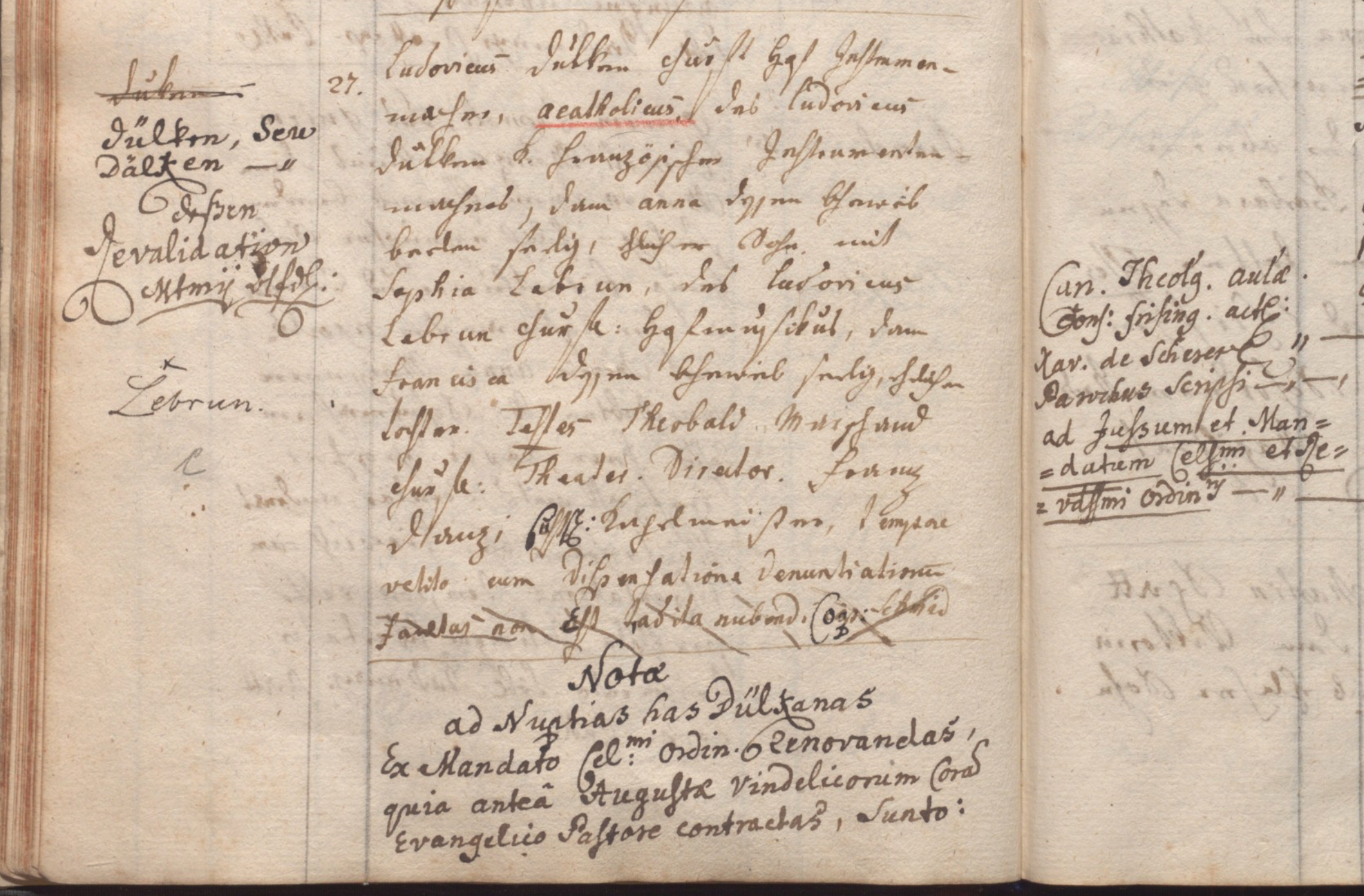
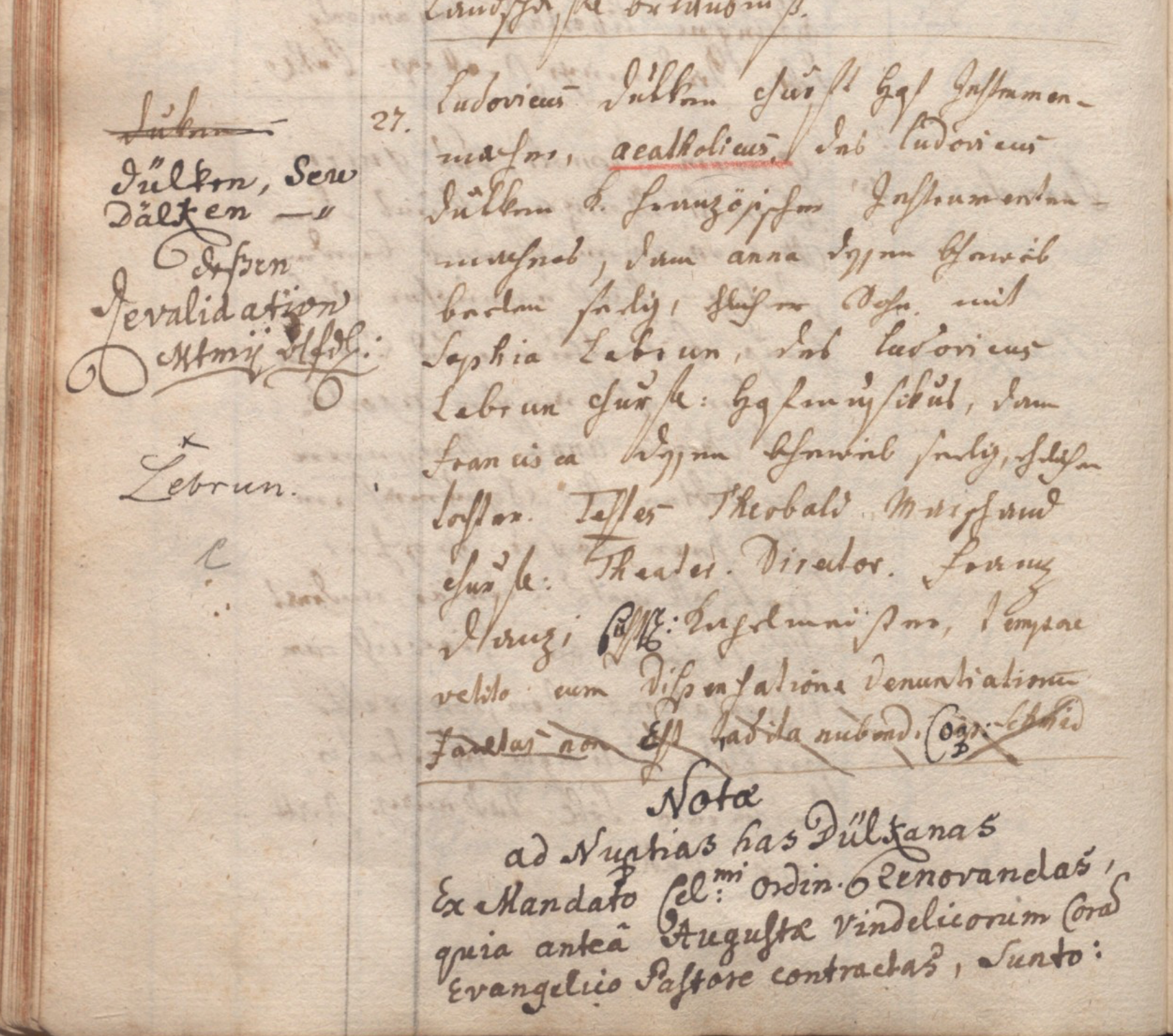
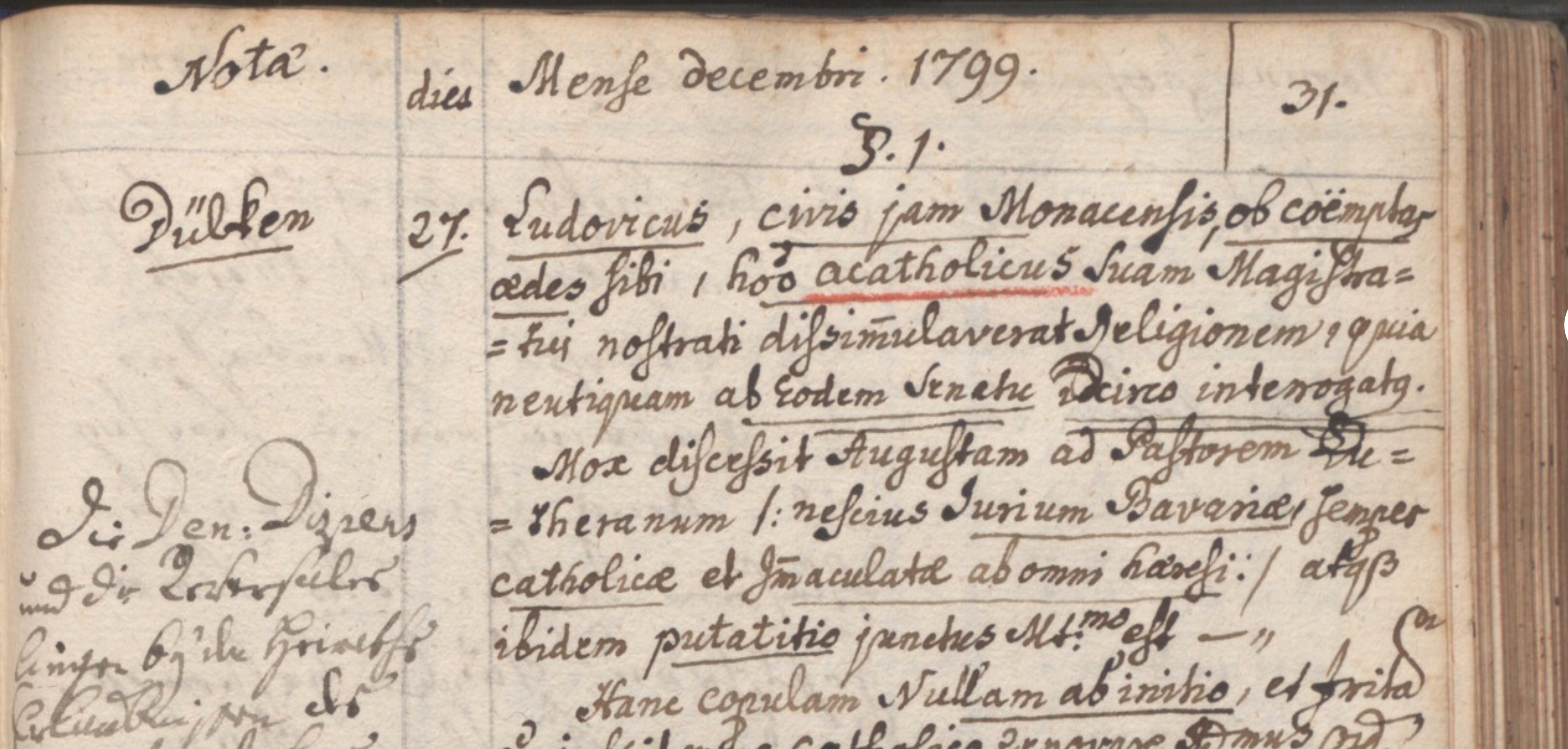
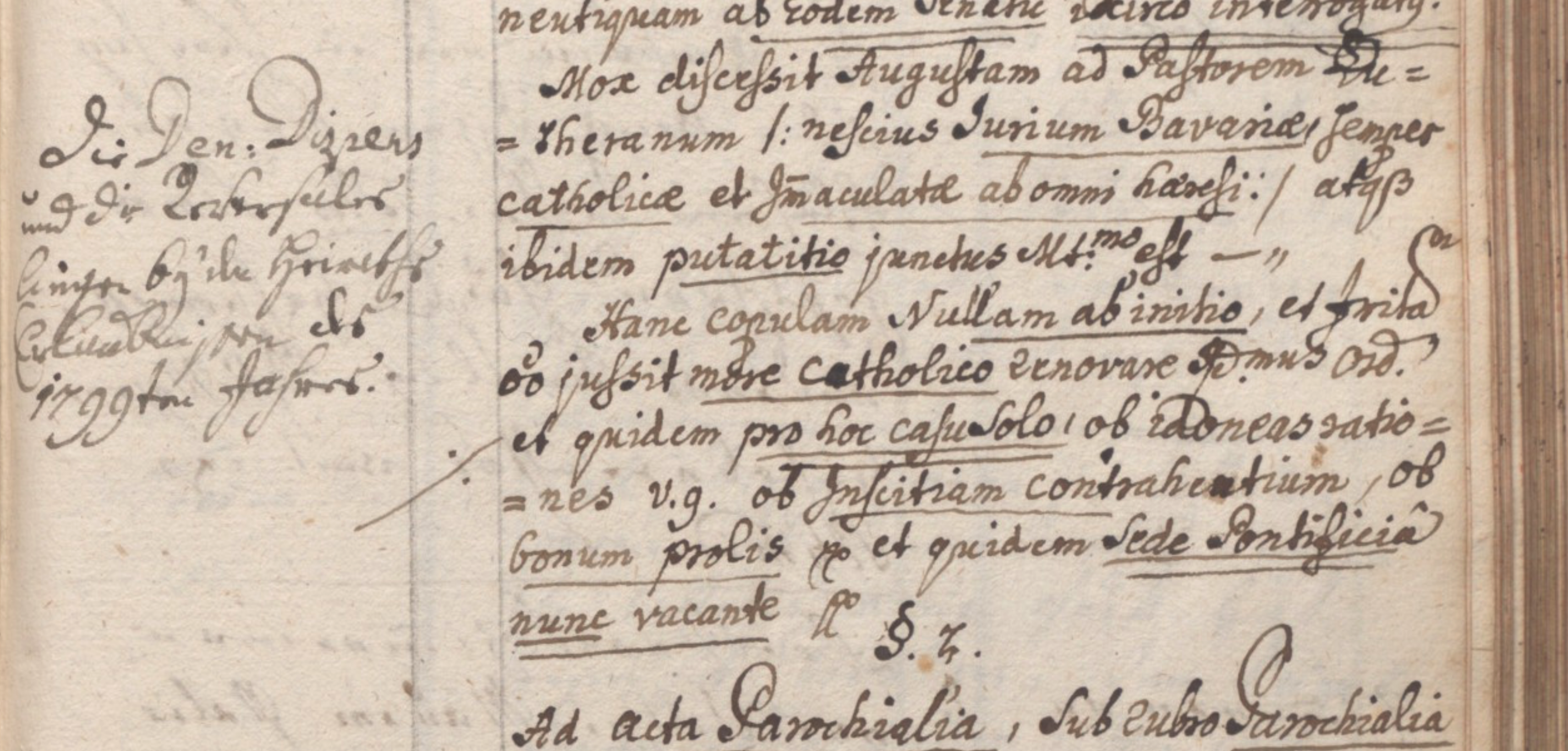
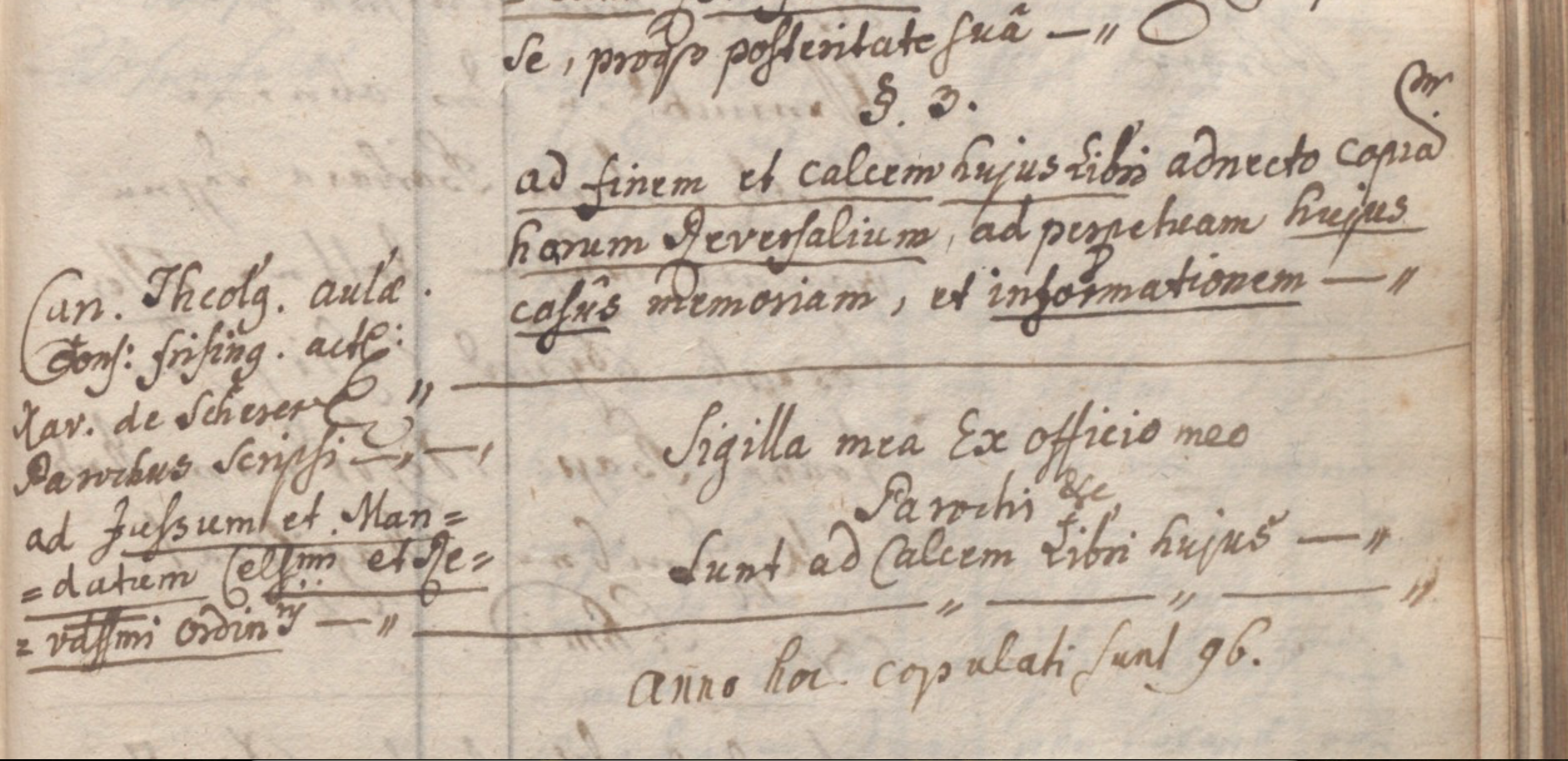
Transcriptie [30verso?] Notae ad nuptias has Dülkanas ex mandato celsissimi ordinis renovandas quia antea Augusta Vindelicorum coram Evangelico Pastore contractas, sunto. [31recto?] § 1 Ludovicus, civis jam Monacensis, ob coëmptas aedes sibi, homo*1 acatholicus suam magistra= tui nostrati dissimmulaverat religionem, quia neutiquam ab eodem senatu idcirco interogatus. Mox discessit Augustam ad Pastorem Lu= theranum (nescius Iurium Bavariae, semper catholicae et immaculatae ab omni haeresi) atque ibidem putatitio junctus matrimonio est. Hanc copulam nullam ab initio, et irritam omnino jussit more catholico renovare Dominus ordinis?*2 et quidem pro hoc casu solo, ob idoneas ratio= nes v.g. (=verbi gratia) ob inscitiam contrahentium, ob bonum prolis pp? et quidem sede pontificia nunc vacante pp? § 2 Ad acta Parochialia, sub conubio Parochialia in extenso jacent coetera omnia, una= cum reversalibus Ludovici Dülken pro se, proque posteritate sua. § 3 ad finem et calcem huius libri adnecto copiam horum reversalium, ad perpetuam huius casus memoriam, et informationem. Sigilla mea ex officio meo parochi etc. sunt ad calcem libri huius anno hoc copulati sunt 96. In de marge [31r] Can. Theol'g aul'ae cons: frising. actae: ? = Freising? Rav. de Scheser…? Parochus scripsi ad Iussum et Man= datum celsissimi et Re= verendissimi?*3 Ordinis Ik, … , pastoor (Parochus), heb dit geschreven op bevel en verordening van de verheven en eerbiedwaardige (klooster)orde. Vertaling Opmerkingen bij dit huwelijk van Dülken dat op bevel van de verheven (klooster)orde herhaald / vernieuwd moest worden omdat het eerder in Augsburg ten overstaan van een Evangelische prediker gesloten was, …?*4 27 december 1799 § 1 Louis, reeds een inwoner van München,*5 had, toen hij een huis ging kopen, als niet-katholiek, zijn geloof voor onze ambtenaar verborgen gehouden, omdat het bestuur hem hier ook niet naar gevraagd had. Kort daarop vertrok hij naar een Lutherse prediker in Augsburg (onwetend van de wetten in Beieren, waar men altijd katholiek is geweest en onaangeroerd door enige vorm van ketterij) en daar dacht hij getrouwd te zijn.*6 De ordemeester? heeft verordend dat deze verbintenis, die vanaf het begin nietig en geheel en al ongeldig was, in dit uitzonderlijke geval, op de katholieke manier herhaald / vernieuwd moest worden, vanwege geschikte redenen, bijv. vanwege de onwetendheid van de betrokkenen, vanwege het welzijn van de kinderen (en omdat er momenteel geen paus is).*7 § 2 Aangaande de Acta Parochialia (=Handelingen van de parochie), alle overige Parochialia zijn, samen met de repliek van Louis Dülken ten bate van hem en zijn kinderen, in hun volledigheid te vinden (in extenso iacent) onder het kopje huwelijk (sub conubio). § 3 Tenslotte en ten einde van dit boek voeg ik deze vele replieken toe, ter eeuwige herinnering aan deze zaak, en ter lering. Mijn zegels overeenkomstig mijn ambt als pastoor etc. (parochus) zijn achterin dit boek te vinden. Dit jaar zijn er 96 [mensen] getrouwd.
*1-ho’o = homo? *2-Dominus ordinis? Het gaat om de hoogste functie binnen een bepaalde religieuze groep. Ik vertaal het maar letterlijk met ‘ordemeester’. De religieuze orde komt vaker ter sprake. *3-reverendissimi’ is het eerste waar ik aan denk, maar of dat er staat weet ik niet zeker. *4-sunto? *5-Monacum, -ch(i)um = München, St., Bayern (Graesse, Orbis Latinus). *6-Augusta [Vindelicorum] = Augsburg (Pinkster, Woordenboek Latijn-Nederlands). *7-Augusta [Vindelicorum] = Augsburg (Pinkster, Woordenboek Latijn-Nederlands). *8’-sedisvacatie’ van 29 augustus 1799-14 maart 1800, paus gevangengezet door Napoleon en in gevangenschap gestorven. Transcriptie - Dr Verena Demoed
Sophia Lebrun, wettige dochter van Ludwig Lebrun, keurvorstelijk hofmusicus, en diens echtgenote Francisca, zaliger gedachtenis. Getuigen: Theobald Marschand, keurvorstelijk theaterdirecteur; Franz Danzic, keurvorstelijk kapelmeester. “Tempore vetito cum dispensatione denuntiationum” = in de gesloten (Advents)tijd, met dispensatie van de huwelijksafkondigingen.
Revalidatio matrimonii = kerkelijke bevestiging van een reeds bestaand, maar canoniek onregelmatig of ongeldig gesloten huwelijk, of een huwelijk tussen partijen van ongelijke religie (acatholicus!).
Tempore vetito verwijst hier vrijwel zeker naar de Advents- of vastentijd, waarin normaal niet getrouwd mocht worden zonder dispensatie.
De aanwezigheid van hoge hofmusici als getuigen past bij beide families (Dülken-instrumentmakers, Lebrun-muzikanten).
Sophia Lebrun, legitimate daughter of Ludwig Lebrun, electoral court musician, and his wife Francisca, of blessed memory.
Witnesses: Theobald Marschand, electoral theatre director; Franz Danzic, electoral chapel master.
‘Tempore vetito cum dispensatione denuntiationum’ = during the closed (Advent) period, with dispensation from the banns of marriage.
• Revalidatio matrimonii = ecclesiastical confirmation of an existing but canonically irregular or invalid marriage, or a marriage between parties of different religions (acatholicus!).
• Tempore vetito here almost certainly refers to the Advent or Lent period, during which marriage was normally not permitted without dispensation.
• The presence of high court musicians as witnesses is fitting for both families (Dülken instrument makers, Lebrun musicians).
Sophia Lebrun, rechtmäßige Tochter von Ludwig Lebrun, kurfürstlicher Hofmusiker, und dessen Ehefrau Francisca, seligen Angedenkens.
Zeugen: Theobald Marschand, kurfürstlicher Theaterdirektor; Franz Danzic, kurfürstlicher Kapellmeister.
„Tempore vetito cum dispensatione denuntiationum” = in der geschlossenen (Advents-)Zeit, mit Befreiung von den Eheankündigungen.
• Revalidatio matrimonii = kirchliche Bestätigung einer bereits bestehenden, aber kanonisch unregelmäßigen oder ungültig geschlossenen Ehe oder einer Ehe zwischen Parteien unterschiedlicher Religion (acatholicus!).
• Tempore vetito bezieht sich hier mit ziemlicher Sicherheit auf die Advents- oder Fastenzeit, in der normalerweise ohne Dispens keine Eheschließungen erlaubt waren.
• Die Anwesenheit hochrangiger Hofmusiker als Zeugen passt zu beiden Familien (Dülken-Instrumentenbauer, Lebrun-Musiker).
Als dertienjarige jongen is Louis Dülcken met zijn vader in Antwerpen aangekomen en betrokken geraakt in een conflict van zijn grootvader Johannes Daniel en zijn vader Johannes Lodewijk met dominee Diepelius van de Olijfbergkerk. Louis is misschien teleurgesteld in de kerk, maar maakt geen compromissen: a-catholicus
Als Dreizehnjähriger kam Louis Dülcken mit seinem Vater nach Antwerpen und geriet in einen Konflikt zwischen seinem Großvater Johannes Daniel, seinem Vater Johannes Lodewijk und Pfarrer Diepelius von der Ölbergkirche. Louis mag von der Kirche enttäuscht sein, aber er geht keine Kompromisse ein: Er ist nicht katholisch.
As a thirteen-year-old boy, Louis Dülcken arrived in Antwerp with his father and became embroiled in a conflict involving his grandfather, Johannes Daniel, his father, Johannes Lodewijk, and the Reverend Diepelius of the Olijfberg Church. Louis may have been disillusioned with the church, but he made no compromises: he remained a non-Catholic
Johannes Lodewijk Dulcken
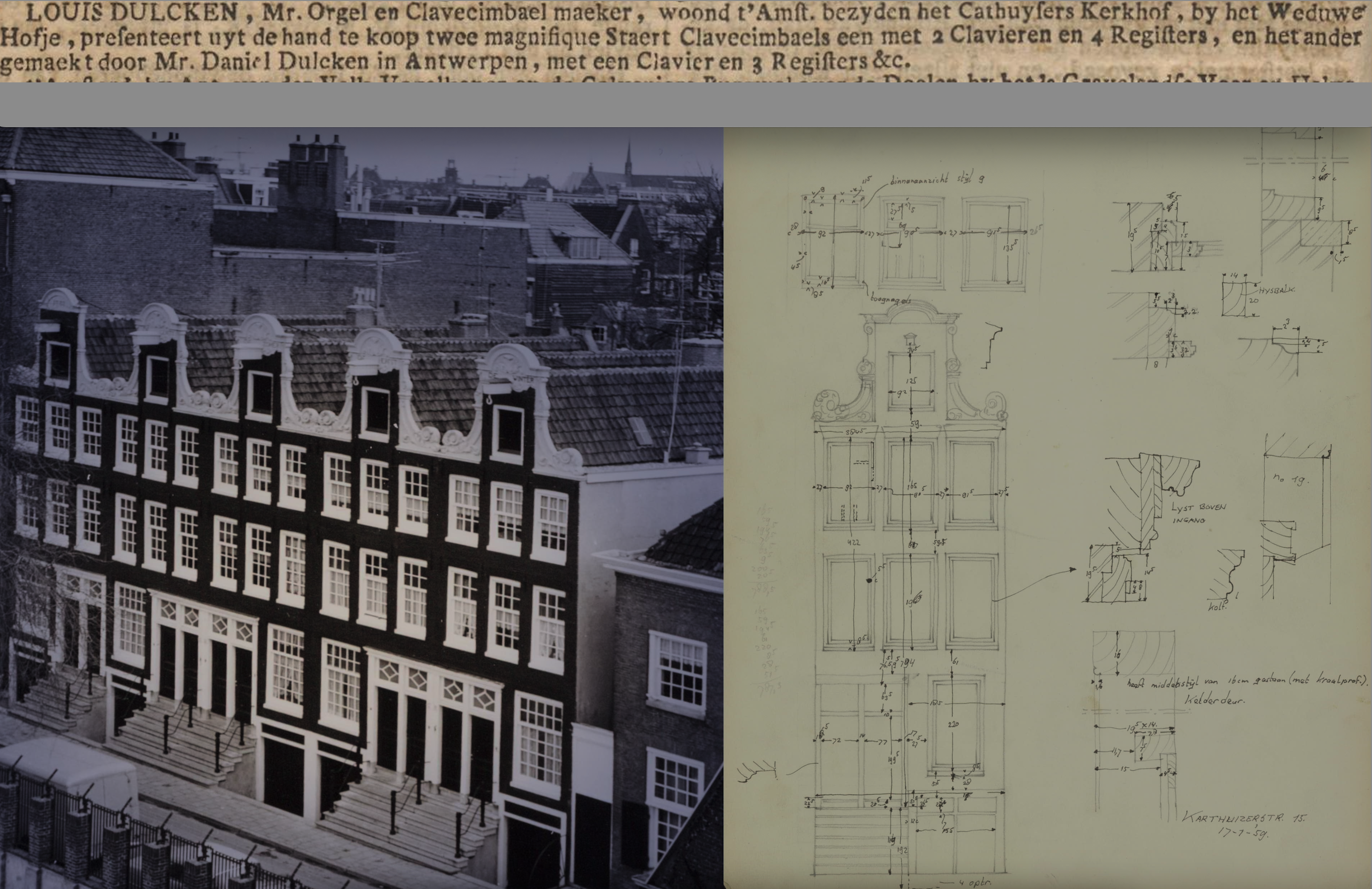
VIDEO DEEL I - Bach Goldberg Var. 30. a 1 Clav. (Cees-Willem van Vliet - Bätz orgel Amersfoort) NOTICE OF INTENDED MARRIAGE IN AMSTERDAM On May 7, 1756, Johan Lodewijk Dulcken (Louis Sr.) of Maastricht filed a notice of intended marriage in Amsterdam with Catrina Koning. His father, Daniel Dulken, from Antwerp, provided the necessary formal consent. A certificate was issued on May 23, 1756, authorizing the marriage to take place in Sloterdijk. CATTHUYSERS STRAAT - WEDUWEHOFJE AMSTERDAM Amsterdamsche courant: LOUIS DULCKEN, Mr. Orgel- en Clavecimbaal-maaker, woonende bezyden het Catthuysers kerkhof t’Amsterdam, presenteerd uit de hand te koop een magnificq Clavecimbaal, zynde een Staartstuk; het geen alle dagen (uitgenomen Sondags) te zien is, ‘s morgens van 9 tot 1, en ’s namiddags van 3 tot 8 uuren. NB. Alhoewel ‘er gezegt word dat zyn welbekend Koninglyk Cabinet-Orgel zoude verkogt weezen, zo adverteerd men mits dezen, dat het zelve nog te koop is. De huizen naast het Weduwehofje Kathuysers Straat staan er nog steeds. De “vier seizoenen” gebouwd in 1731.
The houses next to the Weduwenhofje on Kathuysersstraat are still standing. Known as the “Four Seasons,” they were built in 1731.
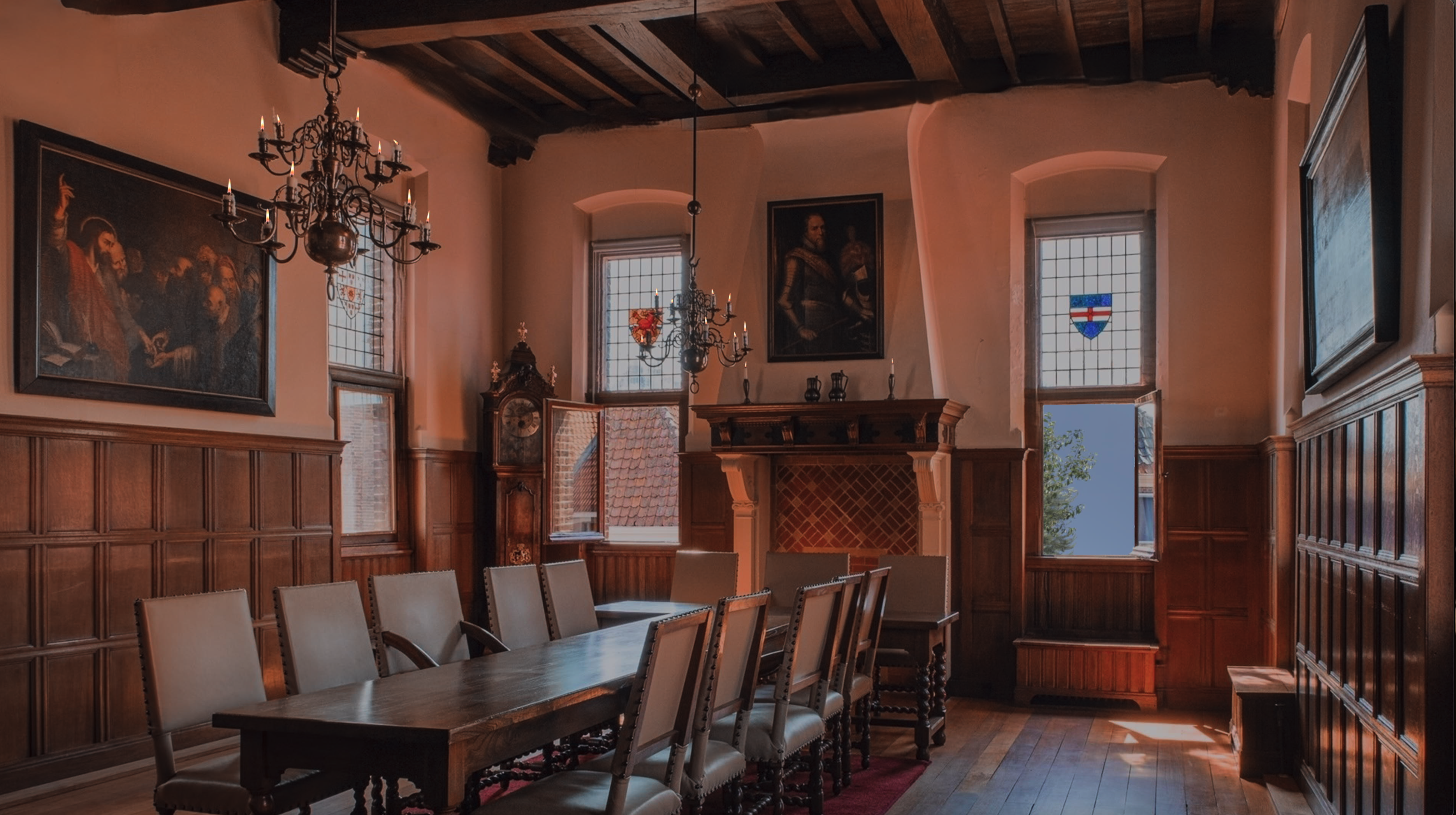
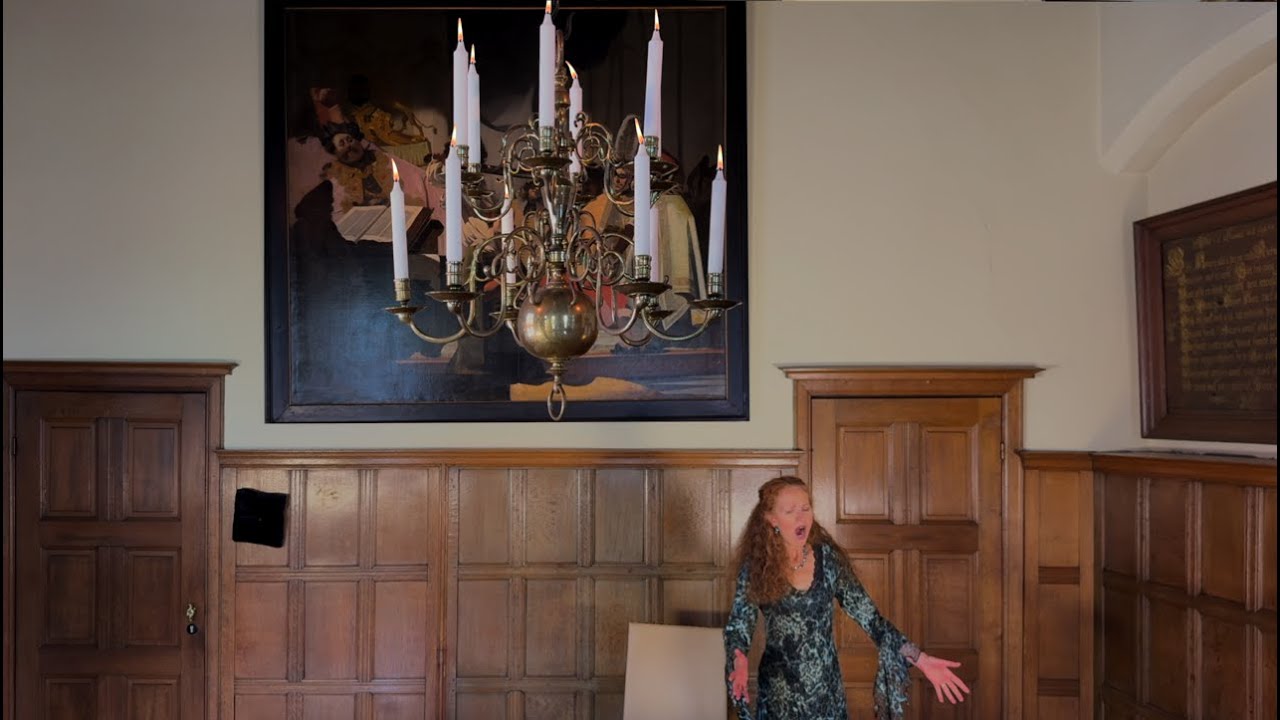
THEMA HAAT OFTE, WEDERWRAAK (Conflict ds DIEPELIUS) VIDEO REGHTHUYS HASSELT In dit gedeelte van de video is het decor de rechtszaal van het Oude Raadhuis voor de Aria Oh mia cor uit ALCINA van Händel.
THEME: HATRED OR REVENGE (Conflict involving Rev. Diepelius) VIDEO: HASSELT COURTHOUSE In this segment of the video, the setting is the courtroom of the Old Town Hall, serving as the backdrop for the aria "Oh mia cor" from Handel’s *Alcina*.
Alcina - Paula Bär-Giese - sopraan Cees-Willem van Vliet - clavecimbel Magistraat - Henk Poelarends
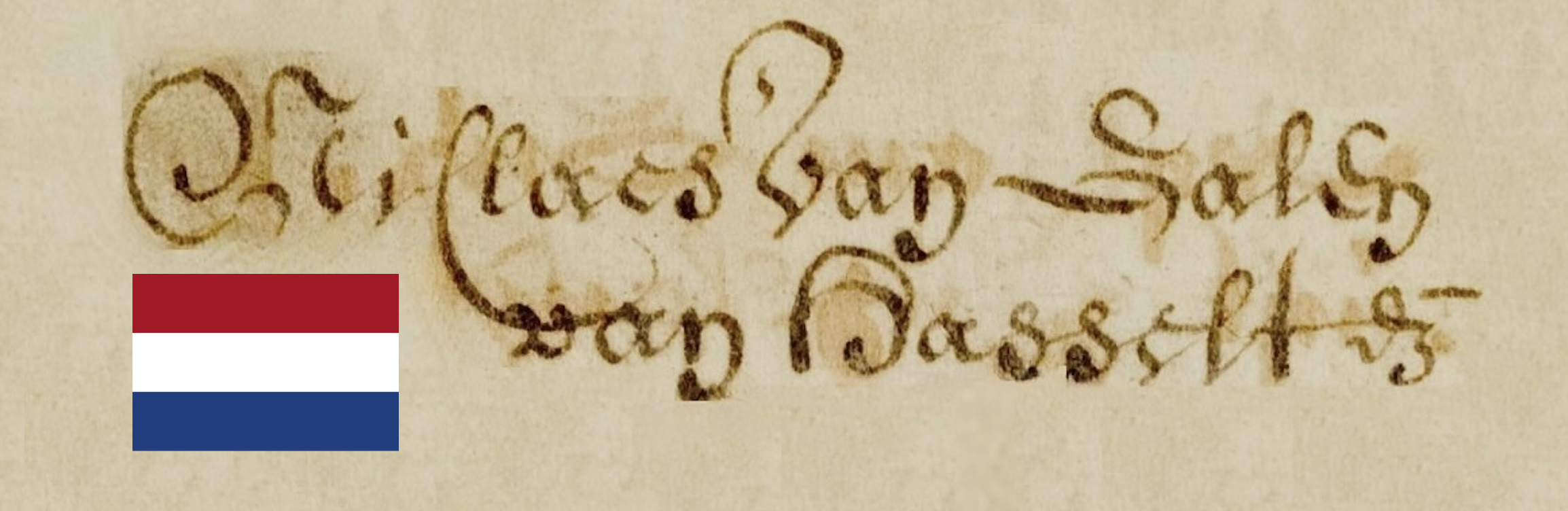
Het leven van Nicolaes van Galen van HASSELT (Overijssel)
VIDEO DEEL III NICOLAES VAN GALEN - JOHANNES VERMEER VAN HASSELT - INFO NICOLAES VAN GALEN Hans Meijer - luit
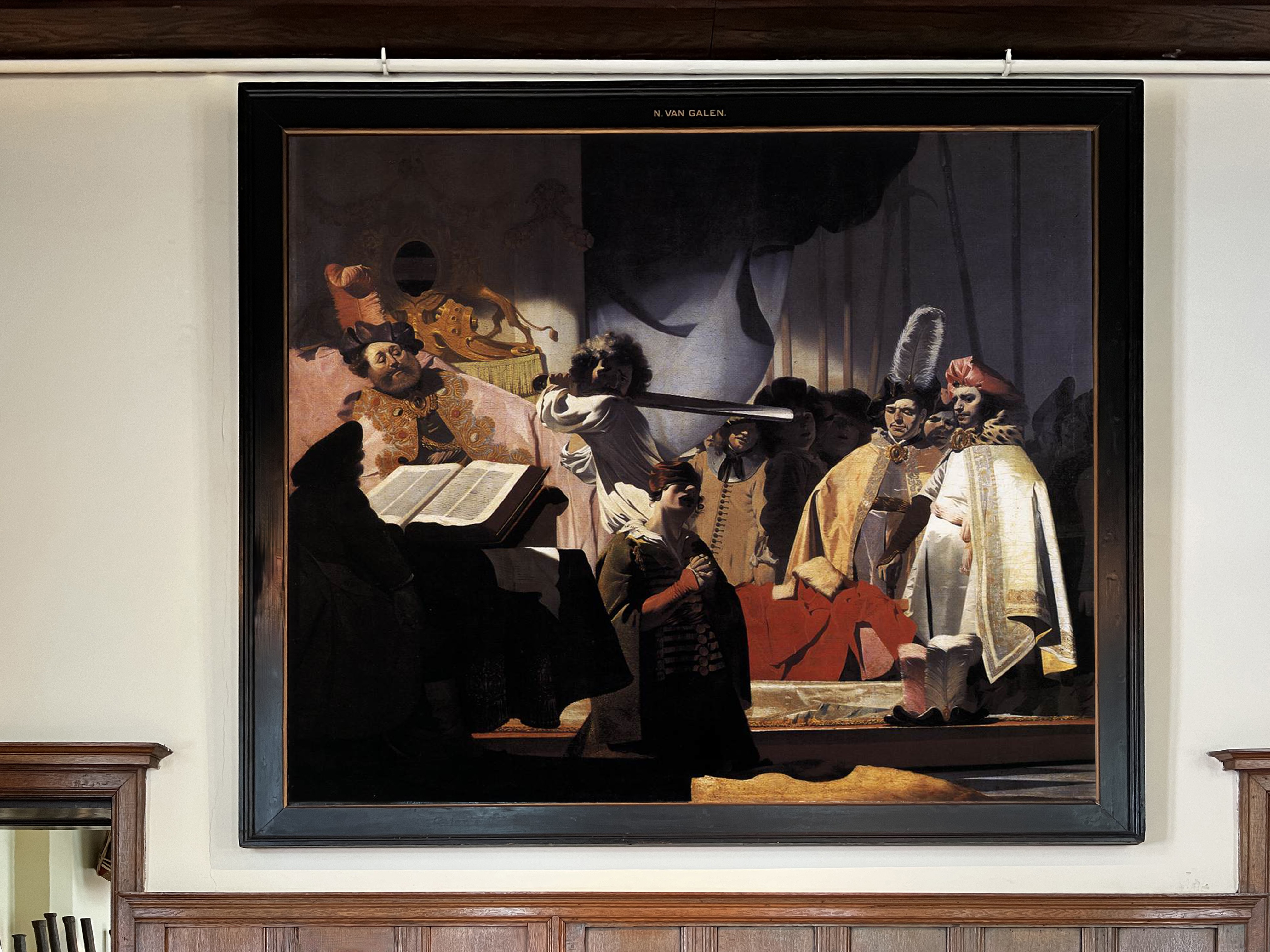
THUS, THROUGHOUT ALL THE PROCEEDINGS, LOUIS DULCKEN STOOD BENEATH THIS PAINTING WITH STEADFAST REGULARITY
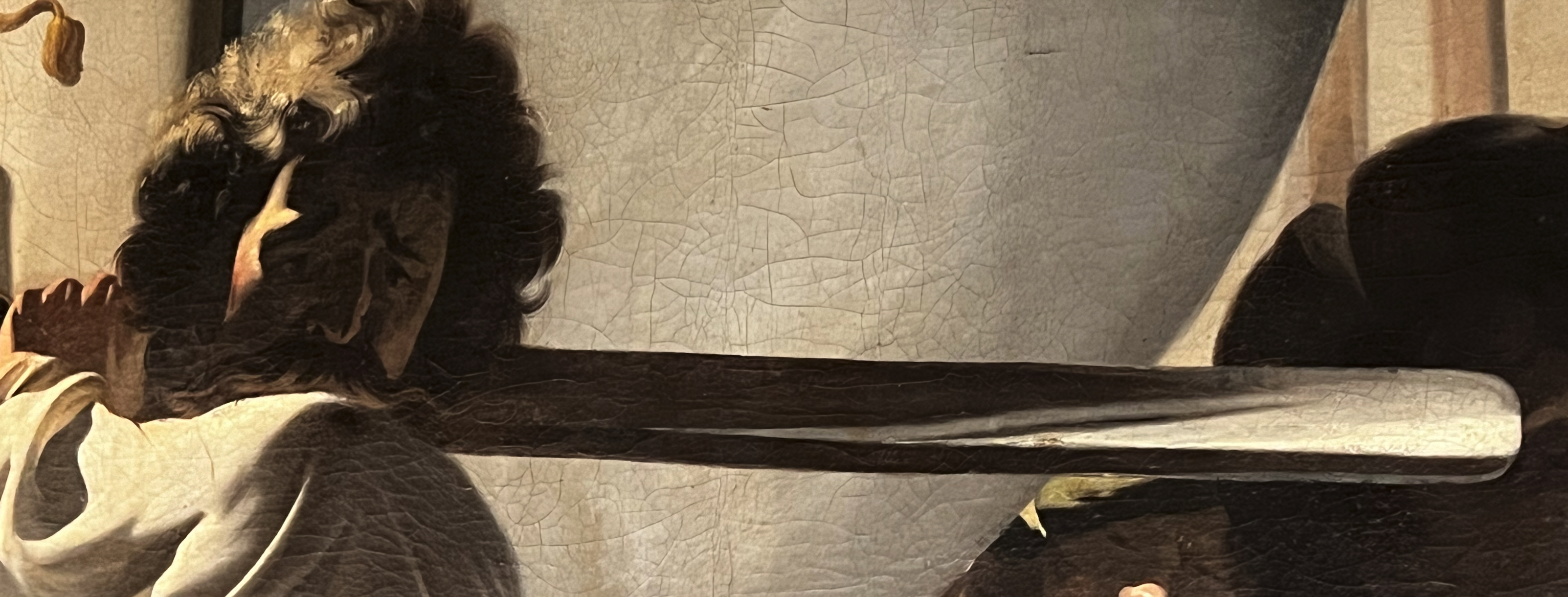
De Rechtspleging van Willem de Goede
(190 x 213 cm) Gesigneerd door N v Galen en gedateerd 1657 vanaf 1657 tot heden OUDE RAADHUIS HASSELT
Het doek is gesigneerd door de in Hasselt wonende N. van Galen. Zoon van Juriaen van Galen en de 'adellijke' Rijkien van Ittersum. Zij was de dochter van de licentmeester en later Hasselter burgemeester Hendrik van Ittersum en Carsien Claesen. In 1605 was zij met Jurrien getrouwd. Nicolaes van Galen zelf huwde in 1649 met de in Amersfoort geboren Johanna Ferreris. De in 1639 geboren zoon van haar oudere broer mr. Bernard Ferreris, Dirck, was eveneens schilder. Van Galen, die inmiddels 2 kinderen had gekregen, Rijckjen (1650)en Theodoor (1652), verbleef in 1652 in Kampen waar hij contact had met de Amsterdamse kunsthandelaar Jacob Ritsma. In genoemd jaar eiste de schilder Claes van Galen in een brief van deze Ritsma de afdracht van het bedrag dat hij ontvangen had voor twee aan hem ter hand gestelde schilderijen. Nicolaes van Galen voegde aan het schilderij F. [ fecit (= maakte)] toe.
(190 x 213 cm) Signed by N. van Galen and dated 1657; held at the Old Town Hall of Hasselt from 1657 to the present. The canvas is signed by N. van Galen, a resident of Hasselt. He was the son of Juriaen van Galen and Rijkien van Ittersum, who was of noble lineage. She was the daughter of Hendrik van Ittersum—a *licentmeester* (official in charge of excise duties/licenses) who later served as mayor of Hasselt—and Carsien Claesen. She had married Jurrien in 1605. Nicolaes van Galen himself married Johanna Ferreris, a native of Amersfoort, in 1649. Dirck Ferreris—the son of Johanna’s older brother, Mr. Bernard Ferreris, and born in 1639—was also a painter. By 1652, Van Galen—who by then had two children, Rijckjen (born 1650) and Theodoor (born 1652)—was staying in Kampen, where he was in contact with the Amsterdam art dealer Jacob Ritsma. In that same year, the painter Claes van Galen sent a letter to Ritsma demanding payment for two paintings that had been entrusted to the dealer. Nicolaes van Galen added the abbreviation "F." (*fecit* — "made by") to the painting.
Het leven van Nicolaes van Galen van HASSELT (Overijssel)