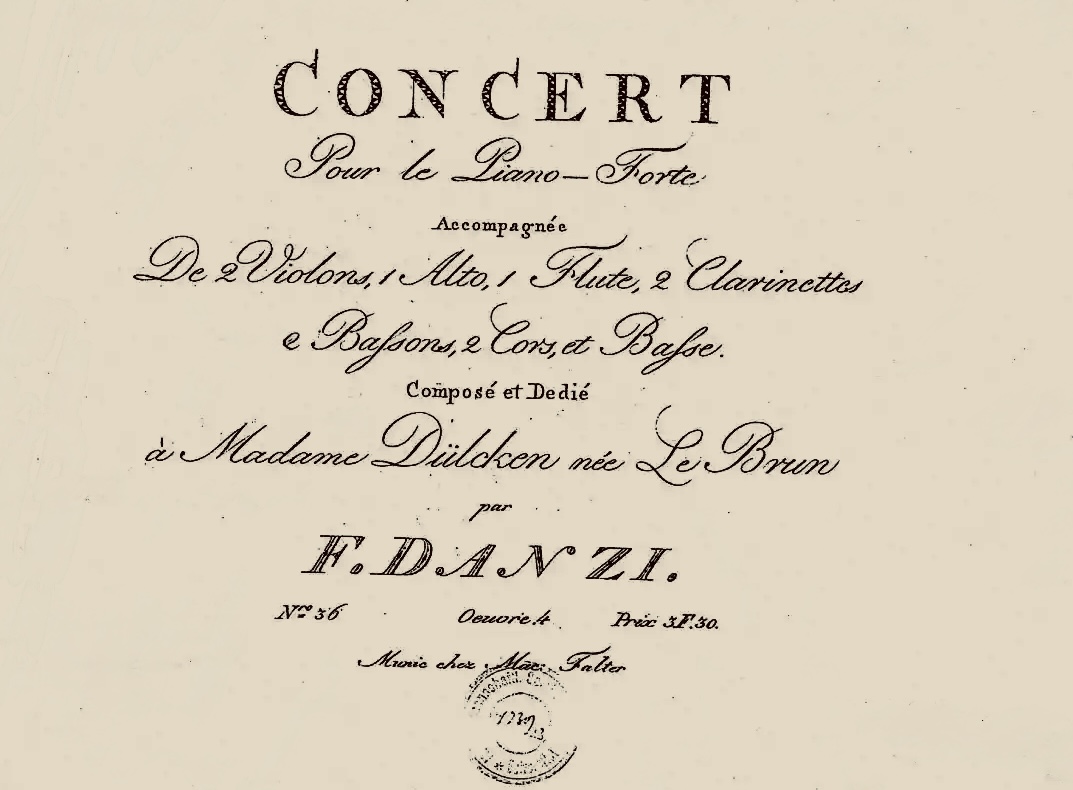
Franz Danzi - Composé et Dedié à Madame Dülcken née Le Brun
Concerto pour le Piano-Forte avec Accompagnement de 2 Violons, Alto, Basso, 2 Flutes, 2 Hautbois et 2 Cors, composé et dédié à Madame Sophie Dulcken née Lebrun par son Oncle Franz Danzi. Oeuvre 4
Danzi's piano concerto for Sophie Dülcken: dating it around 1800
The title page of Franz Danzi's Piano Concerto in E-flat, op. 4 (P 229, published by Falter, Munich) carries the dedication "à Madame Dülcken née Le Brun". That wording is a clue to the dating.
The lower limit: the marriage of 18 April 1799
Sophie Le Brun, daughter of Danzi's sister Franziska Lebrun, acquired the name Dülcken through her marriage to Louis Dulcken.
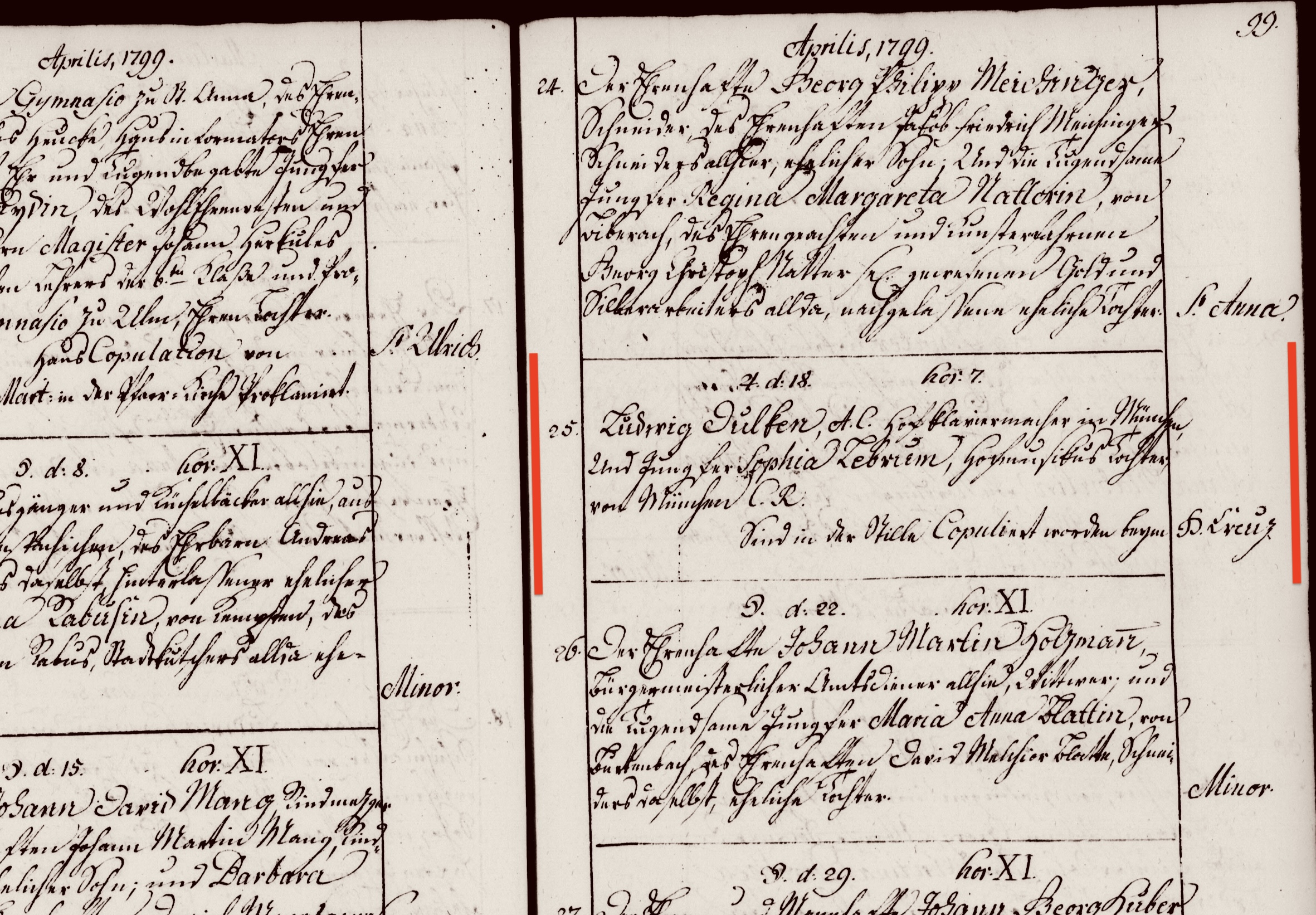
Huwelijk 18 April 1799 Jan Lodewijk (Louis)Dülken x Sophia Lebrun
E.L. huwelijk Augsburg (Bayern / Landeskirchliches Archiv der Evangelisch-Lutherischen Kirche in Bayern / Dekanat Augsburg / Augsburg-Gesamtkirchengemeinde / Trauungen 1796 - 1819, pagina 99, Bild 57):
"Aprilis, 1799 99.
[Donnerstag] d[en] 18. hor[a] 7
25. Ludwig Dulken, A[ugsburger] C[onfession] Hofklaviermacher in München,
und Jungfer Sophia Lebrun, Hofmusikus-Tochter,
von München C[atholischer] R[eligion]
sind in der Stille copuliert worden beijm H[eiligen] Creuz".
Dus de transcriptie betreffende het eigenlijke trouwboek van de ''parochie" Heilig Kreuz betreft dus GEEN E.L. ondertrouw, maar ook E.L. huwelijk.
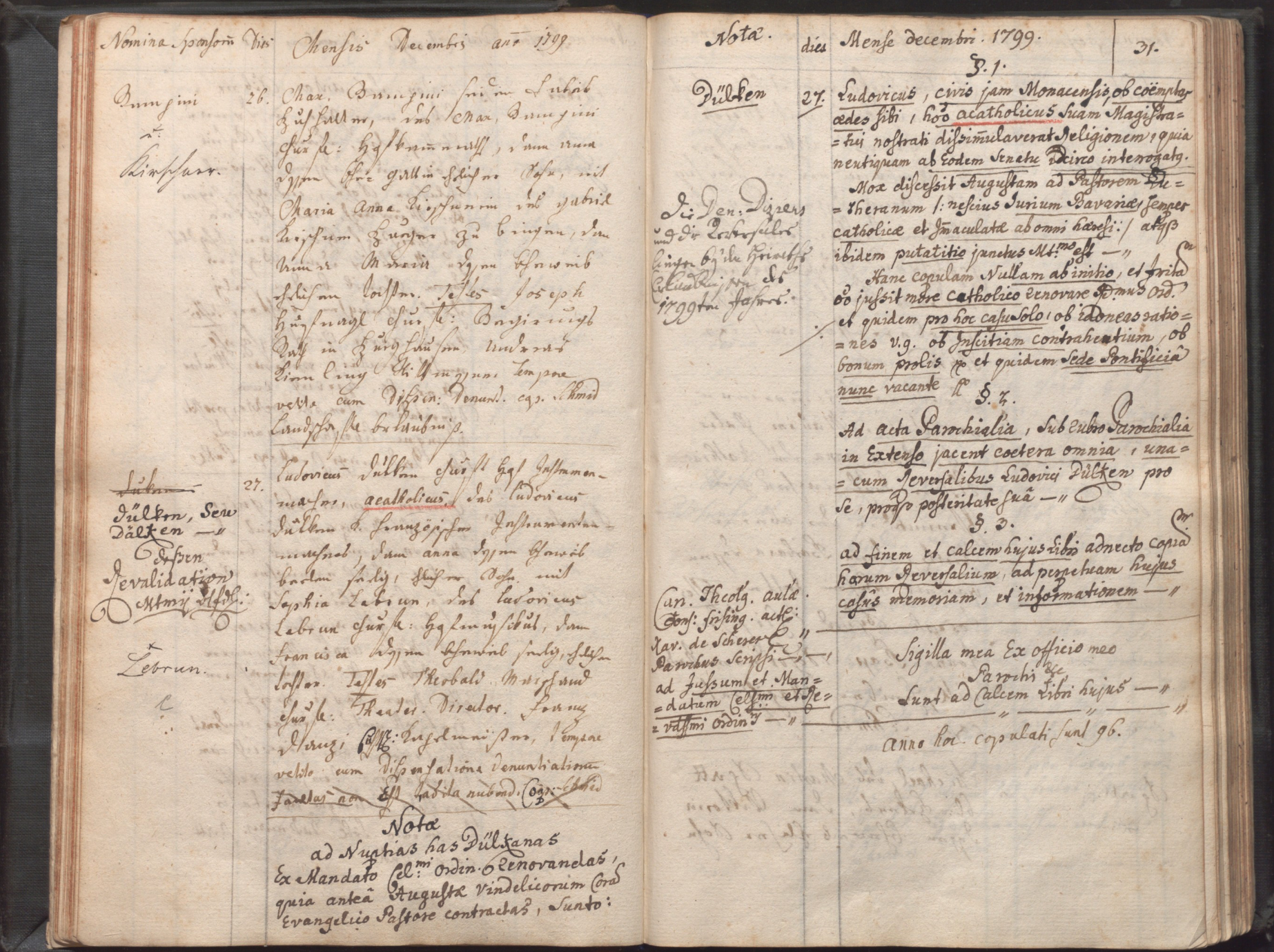
"Nomina Sponsoru[m] Dies Mensis Decembris An[n]o 1799
Dülken, seu 27. Ludovicus Dülken churf[ürstlicher] Hof-Instrumen[ten]m
Dälken macher, acatholicus, des Ludovicus
dessen Dülken k[öniglich] französischen Instrumenten
Revalidation machers, dann Anna dessen Eheweib
m[a]t[ri]m[on]ii ____ beiden seelig, ehlicher Sohn, mit
Sophia Lebrun, des Ludovicus
x Lebrun churf[ürstlichen] Hofmusikus, dann
Lebrun Francisca dessen Eheweib seelig, ehelichen
Tochter. Testes: Theobald Marschand
churf[ürstlicher] Theater-Director, Franz
Danzi c[h]u[r]f[ürs]t[licher] Kapelmeister, tempore
vetito cum dispensatione denuntiationu[m]".
Danzi's piano concerto for Sophie Dülcken: dating it around 1800
The title page of Franz Danzi's Piano Concerto in E-flat, op. 4 (P 229, published by Falter, Munich) carries the dedication "à Madame Dülcken née Le Brun". That wording is a clue to the dating.
The lower limit: the marriage of 18 April 1799
Sophie Le Brun, daughter of Danzi's sister Franziska Lebrun, acquired the name Dülcken through her marriage to Louis Dulcken. The first marriage took place on Thursday, 18 April 1799, at 7 o'clock, "in der Stille" (quietly) at the Heilig Kreuz church in Augsburg. It is entry no. 25 in the Lutheran marriage register, and is therefore a marriage entry, not a banns entry. Ludwig Dulken, court keyboard maker in Munich, was Lutheran (Augsburg Confession); Sophia Lebrun, daughter of a court musician, was Catholic.
The second, Catholic marriage followed on 27 December 1799, in the closed season between Advent and Epiphany and with dispensation from the banns ("tempore vetito cum dispensatione denuntiationum"). The register describes Louis as kurfürstlicher Hof-Instrumentenmacher (electoral court instrument maker) and acatholicus, son of the late Ludovicus Dülken, royal French instrument maker, and his wife Anna. Sophie is the daughter of the late court musician Lebrun and Francisca. The witnesses were Theobald Marchand, kurfürstlicher Theater-Director and father of Margarethe Marchand, and Franz Danzi, kurfürstlicher Kapellmeister.
The name Dülcken was valid in the Lutheran church from 18 April 1799, so the concerto cannot have been written earlier. For Catholic Munich, and for the Catholic court Kapellmeister Danzi, however, the marriage only existed from 27 December 1799. A dedication to "Madame Dülcken" therefore seems more likely after that date than before it, but that is an estimate, not proof.
The notes to the entry give the reason for this second marriage. Louis had become a citizen of Munich after buying a house and had concealed his non-Catholic religion from the Munich authorities, because nobody had asked him about it. He then married in Augsburg before a Lutheran minister, without knowing the Bavarian laws. The ecclesiastical authority regarded that marriage as void from the outset and ordered a Catholic renewal, for this case only, partly in view of the spouses' ignorance and the welfare of any children. The papal see was vacant at the time. Louis also signed a reversal for himself and his descendants.
The upper limit: the publisher Falter
The title page names Falter in Munich but gives no year. The IMSLP works list places the concerto in Munich, 1800. The source of that dating is not given there and must therefore be checked. The neighbouring works provide context: the piano sonata op. 3 appeared as Falter plate 50 (undated), the sextet op. 10 as plate 95 in 1802, and the sextet op. 15 in 1803. The plate number of op. 4 has not yet been traced, but will presumably lie between 50 and 95.
Margarethe Marchand and the year 1800
Danzi's wife, the singer, pianist and composer Margarethe Marchand, died on 11 June 1800. Her own compositions were published by Falter in 1801 and 1802, so publishing activity continued after her death. Biographical sketches stress that the loss dampened his ambition as a composer, and that court conflicts drove him to Stuttgart in 1807. So far only brief sources have been found for this crisis (including Britannica and the ADB).
What this means
The concerto may have been written as a wedding gift between 27 December 1799 and 11 June 1800, when Margarethe was still alive and Danzi had been vice Kapellmeister in Munich since 1798. If the Lutheran marriage of April 1799 is taken as the lower limit, the window already opens in April 1799. It may also have been written during or after his mourning, up to the busy period around 1802. At present no conclusion about the sequence can be substantiated. The crisis after 1800 is the background against which the work appeared, not an explanation of the work itself.
To do
Trace the plate number of op. 4 at Falter (IMSLP, RISM, Bayerische Staatsbibliothek).
Verify IMSLP's dating "Munich 1800" in the Danzi literature (Pechstaedt).
Look for an announcement in the Allgemeine musikalische Zeitung or Munich sources around 1799-1802.
Consult the marriage record from Augsburg and the Catholic confirmation in Advent.
The instrument: a Dulcken fortepiano in Munich
The title page speaks of a concerto "pour le Piano-Forte". According to the archival finds on musicksmonument.com, Louis Dulcken (born 1761 in Amsterdam) became assistant to the Munich piano maker Johann Peter Milchmeyer in 1779. In 1781 he was appointed mechanischer Klaviermacher at the court by Elector Karl Theodor. In June 1782 he took over Milchmeyer's post and, aged 21, became city piano maker of Munich. Sophie Dülcken therefore almost certainly played the concerto on a Dulcken fortepiano: the wife of the court piano maker did not play in public on another maker's instrument. That instrument was, moreover, presumably Louis' wedding gift to his bride.