Multimedia Art Productions

FRANZISKA LEBRUN - DANZI OEUVRE II - SONATA I - ALLEGRO & RONDO; ALLEGRO GRAZIOSO

speakerlogobalk


scherm00adafbeelding-2024-12-20-om-10.04.12
Scherm­afbeelding 2024-12-23 om 10.56.17

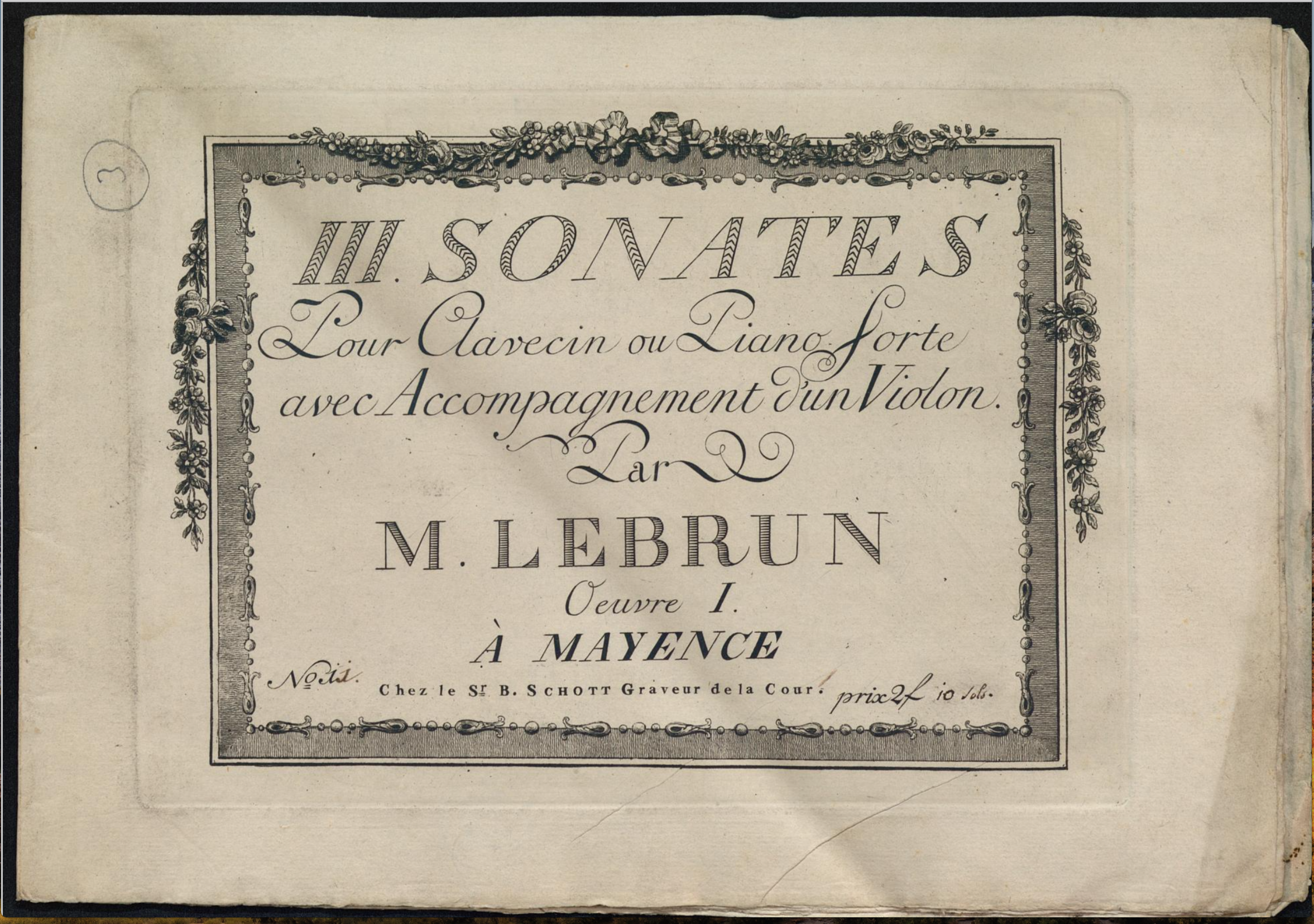
Brün, (Franziska Le), die Tochter des Violonzellisten Danzi zu Mannheim und Schwester des Königl. Würtembergischen Kapellmeisters Franz Danzi, wurde 1759 zu Mannheim geboren. Sie widmete sich der Singkunst, und sang als ein Mädchen von 14 Jahren zum ersten Male im Hofkonzerte in ihrer Vaterstadt. Schon damals war sie die Bewunderung des Churfürstens, und ihres Vaterlandes, und bald darauf auch von ganz Deutschland, Frankreich, Italien und Engeland. Ihre schöne, volle Bruststimme überstieg das drei gestrichene, oder höchste F auf den Klavier-Instrumenten um einen Terz, und alle diese Töne waren gleich stark und angenehm. Es läßt sich keine Vollkommenheit einer Sängerinn fast mehr denken, die ihr nicht eigen war, und ebendaher wetteiferten die schönen Geister Italiens, Engelands und Frankreichs ihre Vorzüge als Sängerinn und Schauspielerinn zu bewundern und in ganz Europa zu verbreiten. Ueberall ließ man ihrer Kunst die verdiente Gerechtigkeit wiederfahren, überall ward sie bewundert, geschätzt, geliebt, und sehr hoch geachtet, einer Todi und Mara wurde sie wenigst gleichgestellt, wo nicht vorgezogen. Im J. 1778 trat sie zu Mailand, nachdem sie ehevor schon in mehrern großen italienischen Opern zu Mannheim mit allem Beifalle gespielt und gesungen hatte, mit den Reitzen und Blüthe der Jugend in der Oper: Europa recognoscitua, mit Musik vom Salieri auf, erwarb sich große Ehre, und ungetheiltes Lob mit sichtbarem Neide und Aerger der dortigen Prima Donna Balducci; mit gleich großem Ruhme sang sie 1781 und 1783 als Prima Donna zu London, dann in der Folge zu Venedig, Neapel u. s. w. und überall ragte sie als eine Deutsche unter den italienischen Sängerinen weit hervor, übertraf sie alle. Die letzten Opern, in der sie zu München sang, waren: Armida, mit Musik von Prati und Castore e Polluce, mit Musik von Vogler. Als sie ihren Gatten den 16. Dezember 1790 in Berlin verlor, war sie untröstlich. Sie erkrankte, und starb, vom stillem Gram verzehrt, daselbst den 14. Mai 1791, zu frühe für die Kunst; ihre Familie, und alle die, so sie kannten, bedauert von jedermann, beweint von ihren Freunden. Ihre 1783 zu Offenbach im Stiche heraus gegebenen drei Klavier-Sonaten, mit Begleitung einer Violine, entsprechen ganz der Erwartung von ihrem Geschmacke, und zeigen zugleich, welch’ vortreffliche Meisterinn sie auch im Klavierspielen gewesen seye. Ihr Leben war ein Gesang; ihr Tod, die Auflösung einer Harmonie.


Franziska Dorothea Lebrun- Thomas Gainsborough (1780)
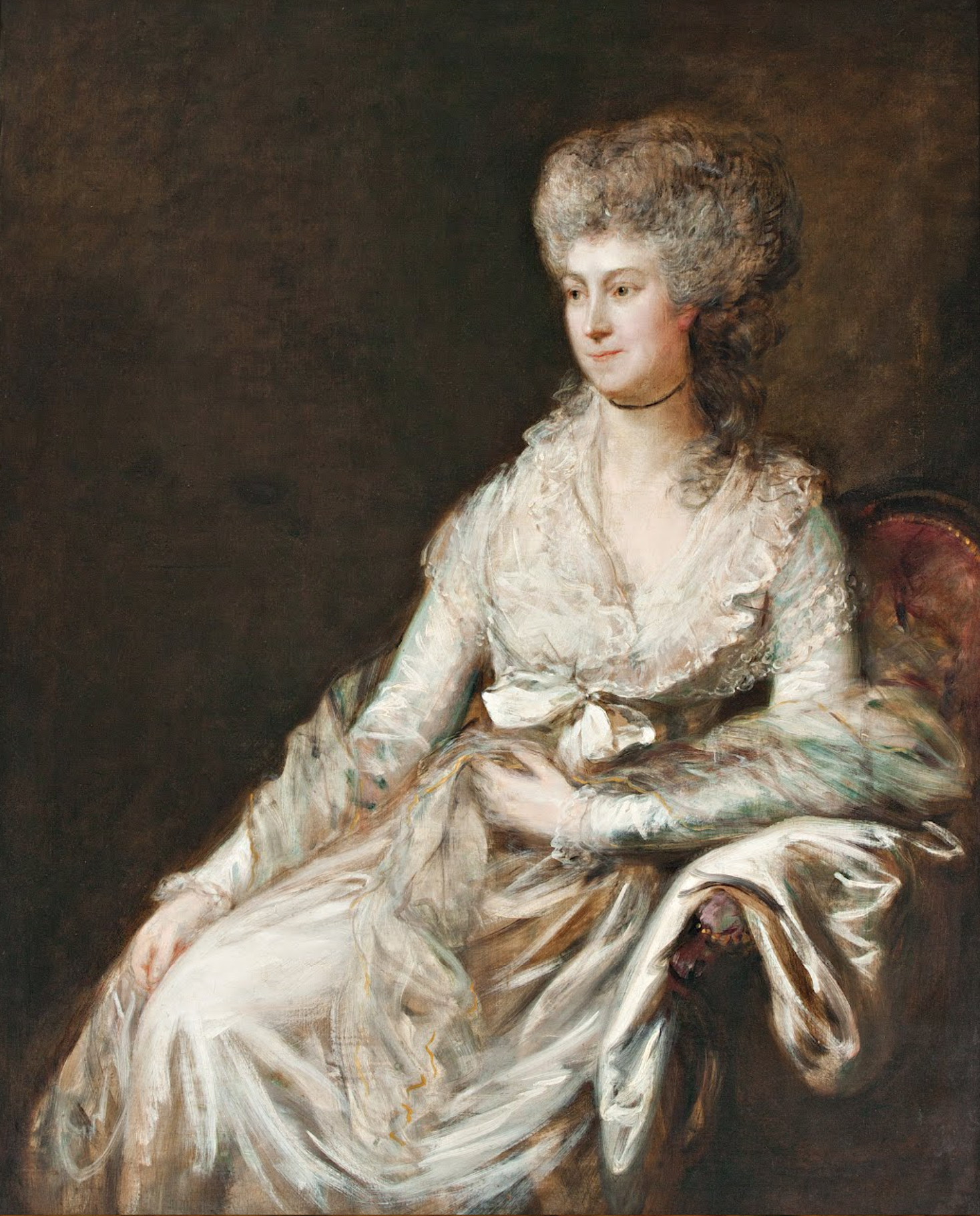
Franziska Dorothea Lebrun - Thomas Gainsborough (1780)

scala milan

On 3 August 1778, Franziska Danzi sang the lead role at the opening of the Teatro alla Scala in Milan in Antonio Salieri's opera Europa riconosciuta (where her success apparently aroused the envy of the local prima donna Balducci) and subsequently in operas by Michele Mortellari, Felice Alessandri and Pasquale Anfossi.


Francesca Lebrun, the primary female representative of the Mannheim School, was born Franziska Dorothea Danzi, daughter of cellist Innocenz Danzi and elder sister of composer Franz Danzi. She probably received musical training from her father and launched on a singing career at age 17, appearing in Sacchini's one-act scena La contadina in corte. Dr. Charles Burney noted her debut, writing "(her) voice and execution are brilliant...she is now a very engaging, agreeable performer, and promises still greater things in (the) future." Her success led to an engagement with the Mannheim court opera that lasted until 1777, when Danzi journeyed to London to appear in operas by Sacchini and Johann Christian Bach held at the King's Theater. During her absence, the courts of Munich and Mannheim merged upon the death of the Carl Theodor, Elector of Bavaria. Upon her return, Danzi married oboist and composer Ludwig August Lebrun, lately displaced as a member of the Mannheim orchestra. Under the name Francesca Lebrun, she embarked on a tour of Europe with her husband. When the Teatro alla Scala opened in Milan on August 3, 1778, with Antonio Salieri's opera Europa Riconoscuita, Lebrun was the prima diva in the cast. Lebrun created a sensation in Paris the following year at the Concert Spirituel through her ability to fit Italian words to instrumental parts of symphonies concertantes and sing them. The Lebruns lived in London from 1779 through 1781, as Francesca fulfilled a two-year-long stint at the King's Theater. In 1780, Francesca Lebrun's portrait was painted by Thomas Gainsborough, and that year she published two opus numbers' worth of Sonatas for fortepiano with violin accompaniment, totaling 12 sonatas in all. These are the only known works of Francesca Lebrun, nonetheless they are solidly crafted in the Mannheim style and adventurous enough to hold up remarkably well even today. Lebrun must've had a formidable piano technique, judging from the level of difficulty of her keyboard parts. The sonatas were an instant hit and were frequently re-published throughout Europe. During her lifetime, Lebrun performed, in addition to the localities named above, in Prague, Vienna, Naples, and elsewhere. In Vienna on March 13, 1785, Lebrun performed at a musicale organized by Wolfgang Amadeus Mozart, with whom she shares exact birth and death years, although there is no evidence the two ever met. Lebrun's husband died suddenly as the pair were to play a series of concerts in Berlin during Carnival season. Ludwig August Lebrun's death proved a blow too great for Francesca Lebrun to withstand, and she died in Berlin just six months later at the age of 35. Francesca and Ludwig August Lebrun had two children, both daughters, who received musical instruction from their uncle, Franz Danzi. Rosine Lebrun (1783-1855) became a singing actress and a mainstay of the Munich theater. Sophie Lebrun (1781-1863) was a famous concert pianist and composer of piano concertos and sonatas, but regrettably none of these works have survived.
Schermafbeelding 2021-08-13 om 18.54.41
Scherm­afbeelding 2025-05-30 om 15.23.02

Soloists and orchestra members of the Orchestra of Elector Karl Theodor - Franziska Le Brün , Ludwig August Le Brün, Innocenz Danzi, Franz Danzi .mechanical piano maker Johann Ludwig Dülken

Scherm­afbeelding 2025-05-30 om 15.18.25


Leopold_Mozart

LEOPOLD MOZART TO HIS DAUGHTER,
1 ST. GILGEN
À Madame / Madame de Sonnenbourg /née de Mozart / à Salzbourg
To be delivered to the Tanzmeisterhaus2
Vienna – Monday, 21st
Febr., 1785

On Wednesday the 23rd, and Monday the 28th there are 2 concerts in the theatre
given by Herr Lebrun and his wife. Even on the 18th there was not a single box more to be had
for the first concert. These people will take in terrifying amounts of money.


Mozart-le brun


Am
Mittwoch dς 23, und Montag dς 28 sind die 2 accademiς
des hς: 
Le brun u seiner Fr: im Theater. Schon den 18 war keine
Loge mehr fürs erste Concert zu bekomς. diese Leute werdς erschröckl:
viel Geld einnehmς.


Dr. Burney's Musical Tours in Europe, Volume II. An Eighteenth-Century Musical Tour in Central Europe and the Netherlands


Charles Burney (1726-1814) took on the three roles of music historian, composer, and musician. His first music books, The Present State of Music in France and Italy… (London, 1771) and The Present State of Music in Germany, the Netherlands, and the United Provinces… (London, 1773), were the results of his extensive travels around Europe. His 1770 trip took him from London to Paris, Geneva, Turin, Milan, Padua, Venice, Bologna, Florence, Rome, and Naples. His second tour, through Germany and the Low Countries, resulted in his second book. All of this was in support of his General History of Music, which came out in 4 volumes (I: 1776, II: 1782, III and IV: 1789).
His daughter, the novelist Frances (Fanny) Burney, wrote a biography of her father after his death in 1814. The Memoirs of Doctor Burney, three in volumes, appeared in 1832 and is where much of the information about Burney’s social circles comes to life.

IMG_5817


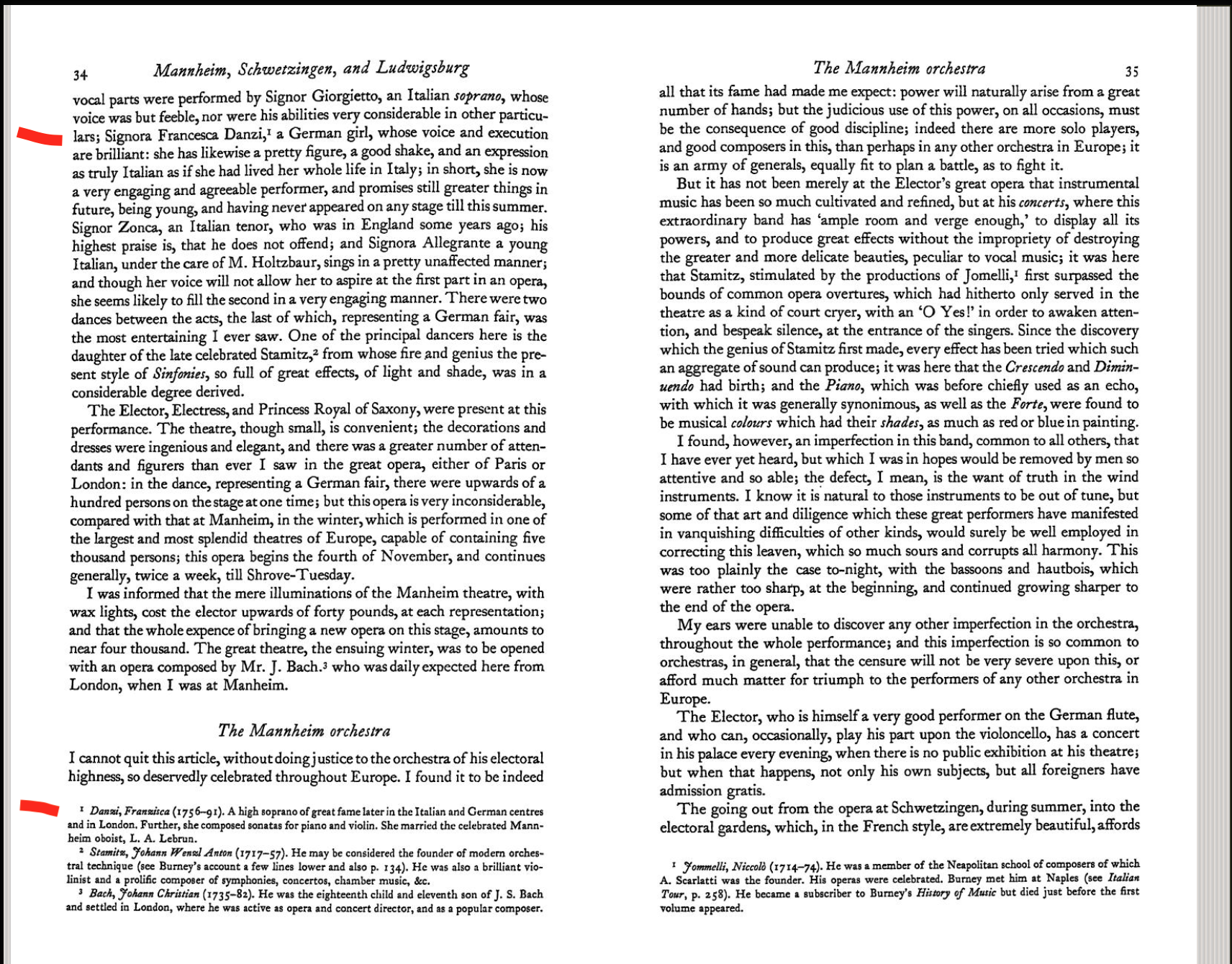
Danzi, Frantsisca (1756-1791). A high soprano of great fame later in the Italian and German centres and in London. Further, she composed sonatas for piano and violin. She married the celebrated Mannheim oboist, L. A. Lebrun.


Signora Francesca Danzi, 1 a German girl, whose voice and execution are brilliant: she has likewise a pretty figure, a good shake, and an expression as truly Italian as if she had lived her whole life in Italy; in short, she is now a very engaging and agreeable performer, and promises still greater things in future, being young, and having never appeared on any stage till this summer.

The Elector, Electress, and Princess Royal of Saxony, were present at this performance. The theatre, though small, is convenient; the decorations and dresses were ingenious and elegant, and there was a greater number of attendants and figurers than ever I saw in the great opera, either of Paris or
London: in the dance, representing a German fair, there were upwards of a hundred persons on the stage at one time; but this opera is very inconsiderable, compared with that at Manheim, in the winter, which is performed in one of the largest and most splendid theatres of Europe, capable of containing five thousand persons; this opera begins the fourth of November, and continues generally, twice a week, till Shrove-Tuesday. I was informed that the mere illuminations of the Manheim theatre, with wax lights, cost the elector upwards of forty pounds, at each representation; and that the whole expence of bringing a new opera on this stage, amounts to near four thousand. The great theatre, the ensuing winter, was to be opened with an opera composed by Mr. J. Bach who was daily expected here from London, when I was at Manheim.


Francesca-2

SIGNORA DANZI


Charles Burney visited Mannheim that same summer 1772 on his tour through Germany. At nearby Schwetzingen he first heard a young soprano, Franziska Danzi (1756–91). Her father was the cellist Innocenz Danzi and her mother Barbara was a sister of the Mannheim composer Carl Joseph Toeschi; her younger brother Franz Danzi (1763–1826) became a renowned composer. Franziska had recently made her stage debut in Florian Leopold Gassmann’s L’amore artigiano in May 1772. Burney heard her perform in Antonio Sacchini’s La contadina in corte on 9 August 1772, and wrote that her “voice and execution are brilliant: she has likewise a pretty figure, a good shake, and an expression as truly Italian as if she had lived her whole life in Italy; in short, she is now a very engaging and agreeable performer, and promises still greater things in the future, being young, and having never appeared on any stage till this summer.”
Burney also mentions that Bach “was daily expected here from London” to complete his opera seria for the gala days in November. Bach’s Temistocle had its premiere at the court theater on 5 November; the cast included Dorothea Wendling (prima donna, Aspasia) and Francesco Roncaglia (primo uomo, Lisimaco), Elisabeth Wendling (seconda donna, Rossana), Giovanni Battista Zonca (bass, Serse), and Anton Raaf (tenor, the title role); Bach was invited to write a second opera for Mannheim, Lucio Silla (1775), with nearly the same cast. Franziska Danzi did not perform in either of these operas, but she probably met Bach at this time. She did perform in two comic operas during Bach’s visit in November 1772: as Olivetta in Niccolò Piccinni’s Le inte gemelle and as the coloratura part of Calloandra in Antonio Salieri’s La fiera di Venezia. Bach would likely have remembered this attractive soprano and her distinctive voice.
Danzi had her first major success in Anton Schweitzer’s Alceste, first performed at Schwetzingen in 1775. She took the role of Parthenia, a coloratura role originally written for Josepha Hellmuth in the Weimar premiere (1773). The success of this work at Carl Theodor’s court led to the commission of a new Singspiel by poet Anton Klein and composer Ignaz Holzbauer, Günther von Schwarzburg, in which Danzi sang the prima donna role of Anna. he celebrated opening of the Mannheim National Theater in January 1777 drew attention and praise from all over Europe, and brought Danzi international fame. The original cast included Anton Raaf as Günther, Ludwig Fischer as Rudolf, Barbara Strasser as Asberta, Queen of Bohemia, who takes revenge on Günther, and Franz Hartig as Karl. Danzi plus the latter three had also performed in Schweitzer’s Alceste; so this was a German opera for a German cast, even if Raaf had been trained and spent most of his career in Italy. Mozart heard the opera in November 1777, and specifically praised Holzbauer’s music; he also mentioned that Danzi was in England, and her replacement, Elisabeth Wendling, did not have a high enough tessitura for this demanding role.

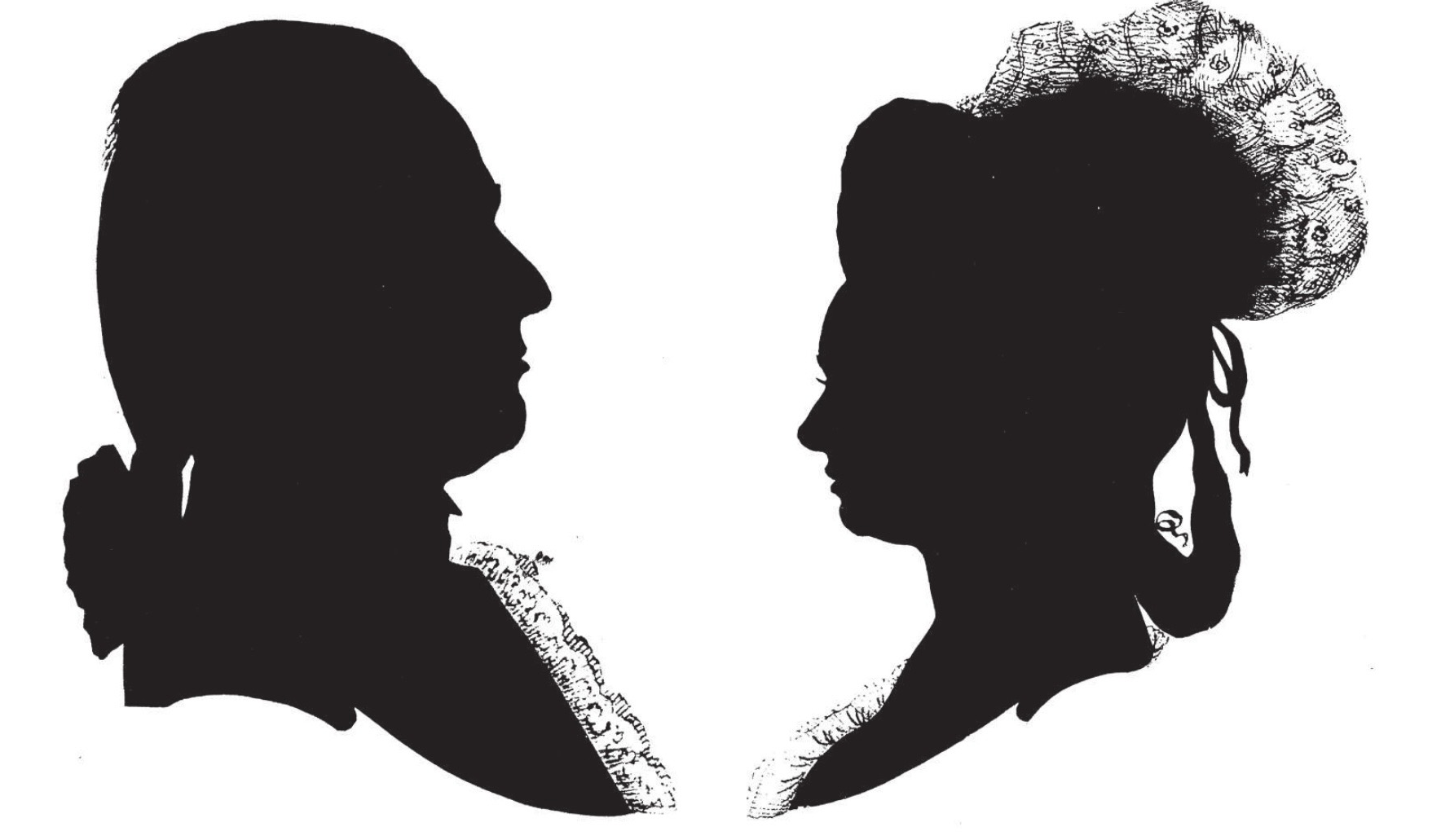
Silhouettes of Ludwig August Lebrun and Franziska Danzi-Lebrun
lebrun
Bach:Danzi
Franziska Danzi had been hired to sing at the King’s Theatre in London for the 1777–78 season J.C. Bach’s La clemenza di Scipione


At the King’s Theatre, London
By February 1777 it was known that the castrato Francesco Roncaglia and Franziska Danzi had been hired to sing at the King’s Theatre in London for the 1777–78 season. We can assume that either J.C. Bach or Burney (or both) had recommended them. They made their debuts in Sacchini’s Creso and later the same season sang in Sacchini’s Erifile and Bach’s La clemenza di Scipione. Antoine Le Texier, a French critic who would later become Richard Sheridan’s opera manager at the King’s Theatre, wrote about the young soprano in some detail:
Mlle Danzi, hired for the prima donna seria roles, has the type of voice that is one of the most extraordinary to hear: an incomprehensibly wide range and above all great accuracy. She sings an aria di bravura in the second act of Creso, a most sublime composition, and which reunites difficulties that another author would not dare to write, imagining it would be impossible to execute. She also has an agreeable countenance, which is suited very well for the theater; she seems to be timid, a defect that could be corrected by the reassurance of the approbation that she will deserve.In the next issue, Le Texier compares her favorably to the soprano Lucrezia Aguiari, who had sung in London the preceding two seasons, 1775–77, and he also mentions that Danzi had been hired to sing in Milan the following season:
Nothing is more astonishing than the extensive range of Mlle Danzi’s voice, if one had enthusiasm for the sharp little cries of Signora Aguiari, when she passed the normal compass of her voice, then one will certainly admire the surprising extent of a natural and agreeable voice, through five octaves, a very extensive span, with an accurate pitch and the most incomprehensible clarity. We have heard that Mlle Danzi is engaged to be the prima donna at the Opera [La Scala] in Milan next year; despite our regrets in losing her, we will be happy to see her move to the country where she can’t help but obtain perfection in singing that one can acquire only in charming Italy, the motherland of all that is musical; this will be the perfect school for Mlle Danzi to improve her singing and acting; she is nineteen [recte twenty-one], her appearance is very agreeable, and truly theatrical, and her acting in which we have discovered great potential, must make one believe also that, with work, she can become an excellent actress.
Burney describes her voice after hearing her sing in London:
As Signora Danzi, now Madame Le Brun, had a voice well in tune, a good shake, great execution, a prodigious compass, and great knowledge of Music, with youth, and a face and figure far from disagreeable; it seems difficult to account for the little pleasure her performance afforded to persons accustomed to good Italian singing. However, the problem certainly admits of a solution, if it be considered, that the natural tone of her voice is not interesting; that she had never been in Italy, and had been constantly imitating the tone and difficulties of instruments; that her chief labour and ambition had been to surprise, concluding perhaps that wonder however excited includes pleasure; and forgetting that though an ounce of salt may make a soup or ragoût sufficiently savoury, yet that two ounces will spoil it; in short, forgetting that she is not a bird in a bush or a cage, and that from a human figure, representing a princess or great personage, it is natural for an audience to expect human passions to be expressed in such tones, and with such art and energy, as will not degrade an individual of our own species, into a being of an inferior order.
This sounds much like his daughter’s description of Danzi-Lebrun’s performance in the pasticcio Alessandro nell’Indie:
Madame Le Brun’s songs, except two, I cannot I confess recollect anything of, but I believe their Style was unmarked — for she cannot sing a Cantabile, which prevents there being much variety in her Airs — but one of the 2 I remember was a chicherichi song in the 2d Act — A Bravura composed purposely for her wch goes up to the high, & a very unpleasing one I think. — Her Husband, who looks a conceited fop, gave the time &c when she sung, & the composition for ought I know might be his — I should suspect her Rondeau in the last Act at least to be his as it is very French.
Sacchini’s Eriile, regina di Zacinto, to a libretto by Giovanni de Gamerra (the poet who wrote Lucio Silla, set by Mozart in Milan, 1772, and later set by J.C. Bach in a modified version by Mattia Verazi in Mannheim, 1775), had its premiere on 7 February 1778 with Danzi in the title role. he most remarkable aria in the opera is Danzi’s aria in act 2, “Lieta quest’alma amante,” with oboe obbligato. She also appeared in Sacchini’s L’amore soldato (5 May 1778) and Tommaso Giordani’s Il re pastore (30 May 1778).
Bach had not written a new opera for the London stage since Carattaco (1767); according to Burney, he had been unwilling to write any operas for London until Anna De Amicis came on the scene in 1762–63. Thus he wrote operas only when the prima donna met his standards, and Danzi must have done so. In the 1770s the taste of the opera-going public had shifted towards lighter forms, and Clemenza di Scipione, in what turned out to be Bach’s final opera for London, reflected some of these trends. Described as a “new Serious Opera . . . with Grand Chorusses,” Clemenza di Scipione had its premiere on 4 April 1778 at the King’s Theatre. According to the Public Advertiser, “the Poetry is said to be the Production of a Foreign Minister residing at our Court; a Person of Taste and Learning, who softens the Cares of Negociation, by sacrificing in secret to the Muses.” The cast included the tenor Valentin Adamberger (later Belmonte in Mozart’s Die Entführung aus dem Serail) as Scipione; Francesco Roncaglia (primo uomo in Bach’s two operas for Mannheim) as Luceio; and Franziska Danzi (prima donna) as Arsinda. These three singers appeared in other operas together, and Mlle Baccelli was one of the principal dancers. From the tone of the enthusiastic accounts of the opera in the Public Advertiser, we can assume that it was a great success. Several arias are mentioned by name and proclaimed to be especially fitting for the singers:
That beautiful Air in the second Act, “Frena le belle lacrime,” sung by Signor Roncaglia, is charmingly pathetic, and well suited to his Voice; as is likewise the one in Act III, “Nel partire, idolo mio;” and that of Signora Danzi in Act I, “Dal dolor cotanto oppresso.” he most capital Air, however, is that of Signora Danzi in the Second Act [“Infelice in van m’afano”], accompanied by the Violin, Violoncello, German Flute, and Hautboy. his is truly a Chef d’œuvre in every Respect, and Signor Bach is extremely fortunate in the amazing Execution of Signora Danzi, and the masterly Accompanyment of Messrs. Cramer [violin], Cervetto [cello], Florio [lute], and Le Brun [oboe]
“Infelice! In van m’afano” is of special importance not only because it is the longest and most elaborate of the arias, but it also bears a resemblance to a sinfonia concertante by virtue of Bach’s employment of four obbligato instruments. In the aria, Bach even gives the voice passages of sequential imitative music in combination with the obbligato instruments, thus creating a unique interplay of voice and instruments. The similarities between this concertante aria and Constanza’s “Martern aller Arten” in Mozart’s Die Entführung aus dem Serail (1782) are striking; Adamberger could have brought the aria to Mozart’s attention in Vienna. Danzi’s voice was clearly in the same league as that of Caterina Cavalieri’s, who was the star soprano at the Viennese National heater. And Bach’s aria, like Mozart’s, is a showcase for soprano (Danzi) as well as the four obbligato instruments.
It is not clear whether Lebrun intended to marry Danzi before leaving Mannheim, or whether the two courted in London (silhouettes of the Lebruns c. 1780).

scherm00adafbeelding-2024-12-20-om-10.04.12
DULCKENLEBRUN LEXICON

Brün, (Sophie Le), die Tochter des berümten churpfalzbaierischen Hofmusikus Ludwig August Le Brün, und der großen Sängerinn Franziska Le Brün, geborne Danzi, wurde zu London den 20. Julius 1781 geboren, lernte die Anfängsgründe der Musik in München bei Knechtl, das Klavierspielen bei Streicher, und den General=Baß bei Schlett, und verheirathete sich mit dem Königl. baierischen mechanichen Klaviermacher Johann Ludwig Dülken in München den 18. April 1799.
Sie ist in jeder Rücksicht eine wahre Künstlerinn auf dem Klavier, und spielt dieses Instrument mit geistvollem Ausdrucke, wahrer Empfindung, und einer ausserordentlichen Fertigkeit.
Als Sie Reisen nach Paris, der Schweiz und Italien machte, bezauberte ihr vortreffliches Spiel jeden Zuhörer, und Kenner und Künstler gestanden ihr den ersten Rang in dieser Kunst zu.
Nebst diesem singt sie sehr artig, hat einen tiefen Blick in das wesentliche der Musik, verbindet mit ihren großen praktischen musikalichen Kenntnissen auch theoretische im gleichem Grade, und versteht gründlich die Komposition.
Für das Klavier hat Sie mehrere Konzerte, Sonaten u. dgl. in Musik geseßt; Schade! Daß dieselben nicht durch den Stich oder Druck allgemein bekannt geworden sind.


Brün, (Sophie Le), de dochter van de beroemde Beierse hofmusicus Ludwig August Le Brün en de grote zangeres Franziska Le Brün, geboren Danzi, werd op 20 juli 1781 in Londen geboren, leerde de eerste beginselen van de muziek in München bij Knechtl, de piano bij Streicher en de basso continuo bij Schlett en trouwde op 18 april 1799 in München met de koninklijke Beierse mechanische pianomaker Johann Ludwig Dülken.
Ze is in alle opzichten een ware pianokunstenares en bespeelt dit instrument met spirituele expressie, echt gevoel en buitengewone vaardigheid.
Toen ze naar Parijs, Zwitserland en Italië reisde, betoverde haar uitstekende spel elke luisteraar en kenners en kunstenaars kenden haar de eerste plaats toe in deze kunst.
Daarnaast zingt ze erg goed, heeft ze een diep inzicht in de essentie van muziek, combineert ze haar grote praktische muzikale kennis met theoretische kennis in dezelfde mate en heeft ze een grondig begrip van compositie.
Ze heeft verschillende concerto's, sonates en dergelijke voor de piano gecomponeerd; wat jammer! Het is jammer dat ze niet algemeen bekend zijn geworden door graveren of drukken.

Brün, (Rosa Theresia Josepha, gedoopt 29 apr 1783 München-Zu Unserer Lieben Frau-kerk)

29 apr 1783 gedoopt, gisteren geboren
Rosa, dochter van Ludwig le Brune, Hofmusikus en Francisca Danzi, doopgetuige Madame Schülz "Kamerdieners Frau"

Scherm­afbeelding 2025-11-14 om 14.42.56

Franziska Lebrun und Wolfgang Amadeus Mozart

Nicht nur identische Geburts- und Sterbejahre verbinden die Komponistin und den Komponisten. Obschon Wolfgang Amadeus Mozart (und seine Mutter) in engerem Kontakt mit Familie Wendling standen, so hatten doch auch Mozart und Franziska Lebrun mehrfach persönlichen Kontakt miteinander. Bei Mozarts Aufenthalt in Mannheim vom November 1777 bis März 1778 waren die Lebruns in London, jedoch hat Mozart von ihnen reden hören, wie die Briefstelle über die Oper
Günther von Schwarzburg zeigt.
Am 29. Juli 1778 schrieb Wolfgang Amadeus Mozart aus Paris nach Mannheim an Fridolin Weber, dass er dessen Tochter Aloysia in diesem Winter leider kein Engagement im Concert Spirituel verschaffen könne.
„weil schon bereits die Mad: Le brun für diese Zeit Engagiert ist - und er [Me. Le gros/Directeur vom Concert Spirituel] wirklich nicht in den besten umständen dermalen ist, um 2 solche personnen nach verdiensten (und wie ich es nicht anderst zuliesse) bezahlen zu können.”[W. A. Mozart: Briefe und Aufzeichnungen, Bd. 2.] (Aloysia Weber war zu diesem Zeitpunkt bereits mit der Familie nach München gegangen, hatte dort eine Anstellung gefunden und war an Mozart eigentlich nicht mehr interessiert.)
Am 10. September 1778 berichtete Leopold Mozart aus Salzburg seinem Sohn in Paris dann vom Umzug der „Mannheimer Musik" nach München und nannte dabei unter den Sängerinnen Mad: Danzy und unter den Oboisten Le Brun.
Am 13. März 1785 müssen sich Wolfgang Amadeus Mozart und die Lebruns im Rahmen einer „großen Akademie" im Wiener Burgtheater begegnet sein. Laut Programmzettel wurde nicht nur Mozarts Kantate
Davidde penitente uraufgeführt, sondern es waren auch „eine Arie, gesungen von Madame LeBrun" und „ein Konzert auf der Hautbois, geblasen von Herrn LeBrun”[Brigitte Höft, a.a.O., 66.] zu hören.
Von weiteren Begebenheiten berichtete Leopold Mozart zwischen 1784 und 1786 seiner Tochter nach St. Gilgen:
[W. A. Mozart, a.a.O., Bd. 3.]
“(..) dan kam noch Måne. Wallenstein eine Hauptactrice des manheimer Theaters, die wegen einem entstandenen theaterkrieg abgedankt hat, und Genugthuung in München sucht, und als heut debutiert: dann kam die August Wendling, die auch debutiert; folglich war des debutierens fremder und neuer Theaterpersonen kein Ende: da noch obendrein Lebrun und seine Frau eben zu der zeit aus Italien zurückkamen: -- also Sängerinen über Sangerinen, kapellmeister über Capellmeister!" (12.11.1784)
„Du weist, daß man immer in der Erwartung war, wer 2da[
2da = Seconda.] Dona werden sollte, da die Lisel Wendling gegen die Mdme: Le Brun keine 2da Donna machen wollte, sonderht: da diesemahl ein gar so nichts bedeutender Part ist mit 2 sehr kurzen schlechten Arietten." (19.11.1784)
„(...) auf den abend aber ist dein Bruder in einem grossen Conzert beym Graf Cizi, wo H: Lebrun und seine Frau sich das erste mahl producieren. (...) H: und Mime Lebrun waren bey uns bis halbe 2 uhr.(...) Mir ist sehr bange, wie es mit der accademie für den Heinrich
[Gemeint ist Heinrich Marchand, der Bruder Margarethe Danzis. Margarethe (Gretl") erhielt in Salzburg 1781-1784 Klavier- und Gesangsunterricht bei Leopold Mozart.] gehen wird, erstlich fand ich, daß er, als ich ihn in München hörte, sich mehr verschlechtert, als verbessert hatte: und seine Geige nicht viel taugt. 2tens kommen just des Le Brun 2 accademien vor seiner: die einen erschröcklichen Zulauf haben. kann ich den H: Lebrun dahin bringen, daß er bey des Marchands accademie etwas blässt, so kann die Sache noch gut ausfallen: sonst ists gefährlich, weil die Unkosten sich schon fast auf 200 f belauffen." (21.2.1785)
„Alle Marchandischen empfehlen sich euch, wie auch die Langischen, Brochardischen; - dann Md:™° Durst, - Heppischen, - Tavernier: etc: - v Hofstettischen etc: Dufraisne - Cannabich: Le Brun und sie, - Bologna etc. und wer weis, wer noch alles." (22.2.1786)
„Le Brun und Bologna werden singen. H: Le brun ein neues Hautbois Concert blasen. (...) Den 6 oder 7 gehen Le brun und seine Frau nach Neapel um alda 4 Opern, das jahr durch, zu singen. Sie gehen über Salzb:, um den Erzbischof um Empfeh- lungsSchreiben nach Rom zu bitten: NB Vermuthlich auch in der Hofnung, daß der Erzb: verlangen möchte, daß sie sich producieren möchten. (...) Ich vermuthe fast, daß H: Le Brun und seine Frau [in der Akademie] singen und blasen wird, weil Le Brun beym Erzb: (nach meiner Einleitung) Audienz nehmen, ihn um Briefe bitten und sich NB ohne Intereße antragen wird par Complaisence et Riconnaißence. das würde folglich den 9
ten geschehen." (1.3.1786)
„H: Le Brun und sie hab schon vorgestern und gestern erwartet, da sie mir sagten sie wollten Montag oder Dienstag abreisen um über Salzb: nach Neapel zu gehen. Vielleicht kommen sie heute. Sie wird vermutlich singen." (9.3.1786)


Die zitierten Stellen lassen die vielfältigen und engen Verknüpfungen der Musikerinnen und Musiker untereinander erkennen. Eine letzte Meldung stammt vom 4.11.1790 und ist von Wolfgang Amadeus Mozart an seine Frau in Wien gerichtet:
„P.S. Die Grethel ist nun mit der Labrun ihren Bruder verheurathet, heißt also Md.m° Danzi."
Ludwig Finscher[Ludwig Finscher: Mozart und Mannheim, in: Finscher 1992, 75f.] verweist auf einen Briefabschnitt aus Mannheim vom 8.11.1777: „Ich habe nichts als aus dem Kopf gespiellt; und drey Duetti mit violin die ich mein Lebetag niemahlen gesehen, und dessen author ich niemahlen nennen gehört habe.”[W. A. Mozart, a.a.O., Bd. 2.] Sollte es sich, so Finscher,[Finscher 1992, 751., Finscher verlegt allerdings das Druckdatum der Sonaten • Franziska Lebruns auf den Winter 1777/78 vor.] nicht in scherzhafter Formulierung um die Violin-Sonaten KV 301-303 handeln, kann durchaus vermutet werden, es seien Mannheimer Violin- sonaten, vielleicht Franziska Lebruns.


 Mozart Briefe und Dokumente – Online-Edition                                                                              


LEOPOLD MOZART TO HIS DAUGHTER,
1 ST. GILGEN
À Madame / Madame de Sonnenbourg /née de Mozart / à Salzbourg
To be delivered to the Tanzmeisterhaus
Vienna – Monday, 21st
Febr., 1785


   Brief, 1785-02-21 und 1785-02-22


Wien – Montag dς 21
                                                                                                  
Febrς. 1785
Mein erstes Schreibς werdet ihr erhaltς habς, – ich glaubte, daß mir die Kälte
von dς Reise gänzlich aus dem Leibe wäre: allein gestern abends merkte ich
Schmerzς am linckς Schenkl, und ehe ich noch ins Bette stieg, fand ich das wirklich
ein
Revmatismus da war. Ich musste demnach heute morgens im Bette Klett=
wurzlthée nehmς und stand erst um halbe 2 auf, um zu mittage zu speisς,
wo mir der Fr: Schwagerin jüngste Schwester
Ms:lle Sophia Gesellschaft leistete,
und itzt wirkl: abends um 8 uhr noch beÿ mir ist, weil dein Brudς, seine Frau,
und der Heinrich Mittags beÿ hς: 
v Trattern speistς, ich mich aber, leider,
entschuldigς lassς musste: Auf den Abend aber ist dein Brudς in einem
grossς 
Concert beÿm Graf Cizi, wo hς: Le brun und seine Frau sich das
erste mahl
producierς; die Schwägerin aber und Marchand sind
im
Concert beÿ hς: v Ploÿer unserm Agenten. Heute wirds wohl
wiedς 1 uhr werdς, bis wir, wie gewöhnlich, ins Bette komς.
den 17, am
donerstage, speisstς wir beÿ deines Bruders Schwiegermutter, dς Frau
Weber, wir warς nur wir 4, die Weberin und ihre Tochter
Sophie,
den die älteste tochter ist in Gratz. ich muß dir sagς, daß das Essen
nicht zu viel und nicht zu wenig, anbeÿ unvergleichlich gekocht war:
das Gebrattene war ein schöner grosser 
Phasan, – alles überhaupts
vortreflich zugericht.
Freÿtag den 18 war tafel beÿm jüngern Stephani,
wo niemand als wir 4, dan hς: 
Le brun, seine Frau, der Carl Canabich
und ein
geistlicher warς. Nun, zum Voraus gesagt, ist hier an keinς
Fastetag zu gedenkς. Es wurde nichts als Fleischspeisς aufgetragς, und
der
Phasan war zur Zuspeise im Kraut, das übrige war Fürstlich,
am Ende
Austern, das herrlichste Confect, und viele Boutellien
champagner wein nicht zu vergessς. überall Coffeé, – das versteht sich.
von da fuhrς wir in deines Brudςs 2
te accademie um 7 uhr auf die
Mehlgrube. die abermahl herrlich war.
Henry spielte ein Violin=
Concert
. der hς: Stephani fragte gleich um dich wiedς, und wir konntς
nicht aufhörς von dς altς Hackς zu redς. Noch hat man hier keine
                                                               fastenspeiß gegeben.

BD_0848_S1
The Salzburg Mozarteum Foundation


den 20 gestern, warς wir beÿ einer Tafl von 21 Personς beÿ hς: Schauspieler
Miller. das war auch herrlich, aber nicht so übertriebς. Er muß ein
grosses
quartier habς, weil er 8 Kindς hat, dafür er 700 f jährlich
bezahlς muß. hς: 
Stephani hat ein kleines quartier, – bezahlt aber 500 f
dafür, weils auf dem Michaelerplatz nahe beÿm Theater ist. –
Am
Mittwoch dς 23, und Montag dς 28 sind die 2 accademiς
des hς: 
Le brun u seiner Fr: im Theater. Schon den 18 war keine
Loge mehr fürs erste Concert zu bekomς. diese Leute werdς erschröckl:
viel Geld einnehmς. – Nun kome auf deinς 2
Brief, da dς erste
ebς einige Minutς vor unserer Ankunft deinem Brudς ge=
bracht wurde. Ich bin äuserst betroffς, daß euer
Fortepiano in einem
so schlechtς Stande ist. – dermahl ist nichts daran zu thun, und
Gott weis, wen und woher dς Egedacher einς Gesellς bekomt. Von hier
ist wenig odς gar keine Hofnung. unterdessς machet Anstallt, daß
ihr mein
grosses Clavicord hinaus nehmt. wen es der geistliche
hς: Egedacher in Salzbς gut einstimt, so wird es sich so leicht nicht
verstimς. Nur daß es sicher in Stroh und wohl zugedeckt hinaus
geführt wird: wen nur jemand wäre, der es sicher in Salzburg
aufgebς könnte. Es muß aus dem fuß herausgehobς werdς:
den fuss legt man dan oben auf die Deckς darauf, daran
liegt nichts. kurz! bringts hinaus! so bald ihr wollt und
könnt.      
Dienstag dς 22. Heut frühe hab abermahl klettwurzς
thee genomς und bin erst um halbe 11 uhr aufgestandς.
hς: und Md:me
Lebrun
waren beÿ uns bis halbe 2 uhr. um 2 uhr giengς wir zum
Mittagessen, wie täglich.
Nun, da dieses schreibe, ists schon wiedς 5 uhr,
es schneÿet ganz erbärmlich und geht ein erstaunlicher Wind, der
die ohnehin wenig gehaitztς Zimer jämerlich ausblässt. Noch war ich beÿ
keinem Menschς, weil zu fuss noch nie aus dem Hauß kam, als nach
St: Stephan um Mess zu hörς, welches sehr nahe ist. Ich bin durch die

BD_0848_S2
The Salzburg Mozarteum Foundation

kältς Winde so abgeschreckt, daß ich gewiß nicht nach Hauß reise, bis
nicht gelinderes Wetter komt. Mir ist sehr bange, wie es mit
der
accademie für den Heinrich gehς wird, erstlich fand ich, daß er,
als ich ihn in Münchς hörte, sich mehr verschlechtert, als verbessert hatte:
und seine Geige nicht viel taugt.
2tens komς just des Le Brun
2
accademiς vor seiner: die einς erschröcklichς Zulauf habς.
kan ich den hς: 
Lebrun dahin bringς, daß er beÿ des Marchands
accademie etwas blässt, so kan die Sache noch gut ausfallς:
sonst ists gefährlich, weil die Unkostς sich schon fast auf
200 f belauffς. genug! wir werdς sehς, wie es geht. Bekannte habe
unterdessς beÿ
accademien angetroffς: zum Beÿspiel, den Baron
                           
van Swieten, beÿ dem auch im Hauß ware, die
                         2 Schwestern die
Gräfin thun und Wallenstein.
                         einς 
Baron Freyberg; Baron Nagl; den Preußς: Residentς
                         hς: 
v Jacobi; den Benedict Edelbach; den hς: v Sonen=
                         
fels u seine Frau. den hς: Starzer, den hς: Aspelmayr[,]
                         den
Fürst Baar; Fürst auersperg; und verschiedene
                         andςe, die mir nicht beÿfallς. – die Haÿrath des Ver=
walter im Johansspithal scheint mir nicht ungeschickt zu seÿn. daß sich
aber die Katherl mit dem Hofapoteker foppen lässt, ist etwas schon
gewöhnliches, – sie macht auf alle Wittwer Anspruch: – ich wünschte
ihrs von ganzem Herzen, er wäre für sie eben nicht zu gut.
Deines Bruders
Carl ist wiedς ganz gesund. Wir alle Küssen euch
von ganzem Herzς, der Fr: Schwagerin Fr: Mutter und Schwester
empfehlς sich gleichfals Beyder seÿts. Dem hς: Sohn muß ich im
Vertrauς sagς, daß ich hier aus einer Unterredung abgenomς, daß
sein hς: Bruder hier seine Frau sehr übl behandelt, und so gar sie
mit Schlägς beehren soll. Nun küsse euch und die Kindς nochmals von
Herzen, und bin dς alte redliche vatter Mozart mp
die Geschichte der Baase in Augspς kanst dir leicht einbildς, ein domherr
hat ihr Glück gemacht. – So bald Zeit habe werde ein höllischς Brief

BD_0848_S3
The Salzburg Mozarteum Foundation


von hier nach Augspς: schreibς, als hätte ichs in Wien erfahren.
das lustigste dabeÿ ist, – daß alle die Presentς, die sie bekahm,
und so aller Welt in die Augς fielen, alles, alles ihr ihr hς: 
oncle
von Salzbς schickte. – welche Ehre für mich! –

BD_0848_S4
The Salzburg Mozarteum Foundation


À Madame / Madame de Sonnenbourg /née de Mozart / à Salzbourg
To be delivered to the Tanzmeisterhaus
Vienna – Monday, 21st
Febr., 1785


The two of you will have received my first letter, I thought that the cold of the
journey had left my body entirely, but yesterday evening I noticed pains in the left thigh,
and before I got into bed, I found that there really was rheumatism there. I accordingly had to
take burdock oil tea and did not get up until half past 1 to eat at midday, at which the younger
sister of my daughter-in-law, Ms:lle Sophia,
kept me company and indeed is still with me
now, at 8 o’clock in the evening, because your brother, his wife and Heinrich ate with Herr
von Trattern at midday, but I unfortunately had to send my excuses:
but in the evening your
brother is at a grand concert at Count Cizi’s,
where Herr Lebrun and his wife will perform
for the first time; but your sister-in-law and Marchand are at the concert at Herr von
Ployer’s, our agent.
Today it will as usual no doubt be 1 o’clock again before we get to bed.
On the 17th, on Thursday, we ate in the home of your brother’s mother-in-law, Frau Weber,
there were only 4 of us: mother Weber and her daughter Sophie,
for the eldest daughter is
in Gratz. I must tell you that the food was not too much and not too little, at the same
time cooked incomparably: the roast was a fine, large pheasant, – everything altogether
outstandingly prepared. On Friday the 18th we dined at young Stephani’s,
where there was
no-one except the 4 of us, then Herr Le brun,
his wife, Carl Cannabich. and a clergyman.


Now, as a preliminary remark, here nobody thinks of keeping a fast-day. Nothing but meat
dishes were served, and the pheasant was in cabbage as a side dish, the rest was princely,
at the end oysters, the most splendid sweetmeats, and not to forget numerous bottles of
champagne. Coffee everywhere, – that goes without saying. From there we drove to your
brother’s 2nd concert in the Mehlgrube at 7 o’clock, which was splendid once again.
Henry played a violin concerto. Herr Stephani immediately enquired about you once
again, and we could not stop talking about the old stories. No-one has served a fast-day dish
here yet. On the 20th, yesterday, we were at a meal with 21 guests given by the esteemed actor
Miller. That too was splendid, but not so exaggerated. He must have a large apartment,
because he has 8 children, and must pay 700 florins per year for it. Herr Stephani has a
small apartment, – but pays 500 florins for it because it is on the Michaelerplatz close to the
theatre. –
On Wednesday the 23rd, and Monday the 28th there are 2 concerts in the theatre
given by Herr Lebrun and his wife. Even on the 18th there was not a single box more to be had
for the first concert. These people will take in terrifying amounts of money.
– Now I come
to your 2nd letter,since the first reached your brother just a few minutes before our
arrival. I am absolutely horrified that your fortepiano is in such a bad state. – At the moment
there is nothing that can be done about it, and God knows when and where Egedacher will
find a journeyman. There is little hope of this, or none at all. Meanwhile make efforts to get
my large clavichord sent out to you. If the clerical Herr Egedacher tunes it well in
Salzburg, it will not go out of tune so easily. Only it must be covered securely and well with
straw before being moved: if only there were someone who send it off safely in Salzburg. It
has to be lifted off the stand: one lays the stand on top of the lid, there is nothing to it. In
short! Get it out there! as soon as you want to and can.

Tuesday the 22nd. This morning I
took burdock root tea once again and did not get up until half past .
Herr and Md:me Lebrun
visited us until half past
. At 2 o’clock we went for our midday meal, as every day. Now, as I
write this, it is already 5 o’clock again, it is snowing quite mercilessly, and there is an
astonishing wind which is blowing lamentably into every corner of this room, which is
heated so poorly anyway. I have not yet visited a single person because I have never been out
of the house on foot except to hear Mass in St. Stephan’s, which is very near. I am so deterred
by the cold winds that I certainly will not travel home until milder weather comes. I am very
anxious about how the concert for Heinrich will go: first of all, I found when I heard
him in Munich that he had got worse rather than better, and his violin is of no great quality.
Secondly, the 2 concerts by Le Brun,
which are attracting terrifying numbers, precede his. If
I can bring Herr Lebrun to play something at Marchand’s concert, the matter may yet turn out
well; otherwise it is risky, because the costs alone amount to almost 200 florins. Enough!
We will see how it turns out.

In the meantime I have met acquaintances at concerts: for

example, Baron van Swieten,
whom I also visited in his home, the 2 sisters Countess Thun
and Wallenstein. A Baron Freyberg; Baron Nagl; the Prussian representative Herr von
Jacobi; Benedict Edelbach; Herr von Sonnenfels and his wife. Herr Starzer, Herr
Aspelmayr,Prince Baar; Prince Auersperg; and various others who no longer come to
mind. – The marriage of the administrator at the Johannsspithal seems to me not infelicitous.
But Katherl allowing herself to be teased over the court apothecary is certainly something
familiar, – her ambitions extend to all widowers: – I would wish it for her with my whole
heart, the point is that he would not be too good for her. Your brother’s Carl is completely
well again. We all kiss you both wholeheartedly, your worthy sister-in-law, her worthy
mother and sister likewise commend themselves. I must tell my esteemed son confidentially
that I gathered from a conversation here that his esteemed brother treats his wife most
execrably here, and is even said to regale her with blows. Now I kiss you both and the
children from the heart once again, and am as always your sincere father,

Mozart
You can easily imagine the story of your cousin in Augspurg, a cathedral canon filled her
cup of happiness. – As soon as I have time I will write a hellish letter from here to Augspurg,
as if I had heard about it in Vienna. The funniest thing about it all is – that all the
presents that she received and which everyone noticed, all, all of them were sent to her by her
uncle in Salzburg. – What an honour for me! –


Idomeneo_frontespizi kopie 2 2

Kurpfalz: Seiner Churfürstlichen Durchleucht zu Pfalz etc. etc. Hof- und Staats-Kalender für das Jahr .... 1781

Scherm­afbeelding 2025-05-30 om 12.50.37
2

3

37
5

In the autumn of 1789, Franziska was engaged by Johann Friedrich Reichardt as the first singer for the carnival at the Royal Opera House in Berlin.
“Last month, His Majesty the King sent Mr Reichardt to Munich to obtain permission from the Elector's court for Madame Lebrun, who performed here six years ago to great acclaim, to sing the lead role in the local Grand Italian Opera during the upcoming carnival season. Madame Lebrun, formerly Danzi, arrived here several weeks ago and, together with her husband, who is now widely recognised as the foremost virtuoso on the oboe, has already performed several times in concerts for His Majesty the King, receiving the same great acclaim that both have long enjoyed in England, France, Italy and Germany. Madame Lebrun will make her first appearance at the theatre on 4 January in the opera Brenno by Kapellmeister Reichardt”. [Musikalische Real-Zeitung vom 6.1.1790, 7.]

1790-7

On 8 December, she performed in Reichardt's ‘Tedeum’ with great success, and ‘in it, the audience heard Madame Lebrun from Munich for the first time, who had been engaged by His Majesty for the upcoming carnival.’ [Musikalische Real-Zeitung, 13 January 1790]

1790-7-1
1790-1-2

On 27 January, the Musikalische Real-Zeitung reported: "Yesterday, the opera Brenno, composed by the Royal Kapellmeister Mr Reichardt, was performed to extraordinary effect and general acclaim. His Majesty, the King, was seated in the stalls next to the orchestra and repeatedly expressed his utmost satisfaction. Madame le Brun sang the first role with exceptional interest and great skill and also satisfied far more than could have been expected from any successor to Madame Todi in terms of her acting. She earned the most distinguished applause from the King and the entire audience”. [Musikalische Real-Zeitung, 27 January 1790]

1790pag 29
1790-29-1


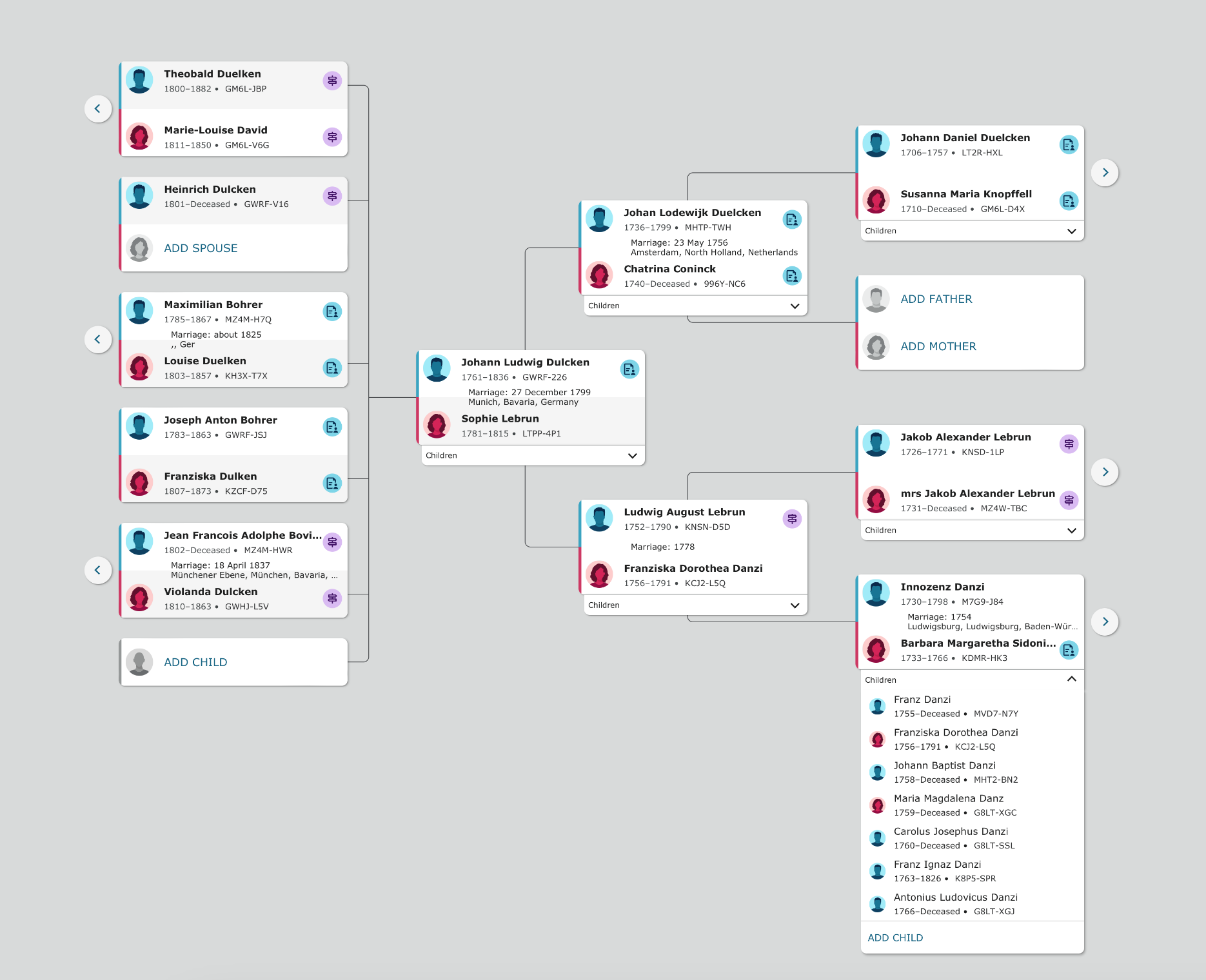
THE DULCKEN FAMILY, INSTRUMENT MAKERS - MUSICIANS


Johannes Daniël Dulcken (21 april 1706 – Antwerpen 11 april 1757) x Susanna Maria Knopffllin
Johannes Lodewijk (Louis)Dulcken I (1735 - † tussen 1793 en 1795 München) x Catharina Koning
Johannes Lodewijk (Louis) Dulcken II (1761 - † München 1836) [brother Johannes Dulcken ( 26 December 1768 - ?)]

Louis Dulcken x Sophie Le Brün

Brün, (Sophie Le), the daughter of the famous Bavarian court musician Ludwig August Le Brün, and the great singer Franziska Le Brün, née Danzi, was born in London on 20 July 1781, learnt the basics of music in Munich with Knechtl, the piano with Streicher, and the basso continuo with Schlett, and married the royal Bavarian mechanical piano maker Johann Ludwig Dülken in Munich on 18 April 1799. She is a true artist on the piano in every respect, and plays this instrument with spiritual expression, true feeling and extraordinary skill. When she travelled to Paris, Switzerland and Italy, her excellent playing enchanted every listener, and connoisseurs and artists conceded her the first rank in this art. In addition to this, she sings very well, has a deep insight into the essentials of music, combines her great practical musical knowledge with theoretical knowledge to the same degree, and has a thorough understanding of composition. She has composed several concertos, sonatas and the like for the piano; it is a pity that they have not become generally known through engraving or printing. On 25 June 1831 Louis Dulcken relinquished his post as royal keyboard instrument maker; he died five years later. In his will Dulcken named as heirs his wife Sophie Lebrun (b London, 20 June 1781–d Munich, 23 July 1863), his sons Theobald and Heinrich, his married daughters Louise and Franziska Bohrer, and his then unmarried daughters Violande, Johanna, and Caroline Dulcken. Theobald as business manager and Heinrich as builder apparently completed their father’s commitments after his death but soon closed the shop. Both sons eventually moved to London where Theobald became a wool merchant and Heinrich an organist. Louise and Franziska had married the brothers Max and Anton Bohrer; Louise became court pianist in Stuttgart. Violande became a concert singer in Munich. Dulcken's son Theobald became Louis partner about 1816, and the business continued until 1831, when Louis Dulcken retired.


1800 - Theobald Ludovicus, zoon van Jan Lodewijk (Louis) en Sophia - Théobald Dulcken - Married in 1828, Munich, Bavière, Allemagne, to Louise Marie David 1811-1850

1801 - Philippus Henricus, zoon van Jan Lodewijk (Louis) en Sophia - Heinrich Dulcken, organist - Married to Auguste Burghaagen


1803 - Louise, dochter van Jan Lodewijk (Louis) en Sophia

Female piano prodigies:(with their ages at the time of their first public performance) Louise Dulcken, married to Bohrer (1803–1857), aged 11
Leopoldine Blahetka (1809–1885), aged 8
Fanny Sallamon (1809–after 1839), aged 10
Antonie Oster (1811–1828), aged 10
Louise David, married to Dulcken (1811–1850), aged 10
Marie Moke, married to Pleyel (1811–1875), aged 8
Delphine Schauroth (1813–1887, aged 9
Josephine Seipelt (1816–1841), aged 9
Clara Wieck, married to Schumann (1819–1896), aged 10
Freia Hoffmann, Instrument und Körper, Frankfurt am Main, Leipzig 1991, chapter ‘Wunderkinder’, pp. 309–335; Ingrid Fuchs, ‘,Bewundrungswerthes Kind! deß Fertigkeit man preißt …’

Louise Dulcken kreeg samen met haar zus Fanny pianoles van hun moeder. Hun eerste openbare optreden vond plaats in 1814 in München. 20 jul 1824 trouwde ze met cellist Max Bohrer (1785-1867). Haar zus Fanny trouwde 20 jul 1824 met zijn broer Anton. In 1826 werd hun zoon Carl Theodor geboren. In 1827 verhuisden beide echtparen naar Parijs, waar ze samen concerten gaven. In augustus 1828 schreef de Münchener Allgemeine Musik-Zeitung over een concert in Parijs: "Mad. Max. Bohrer, die nog niet in Parijs te horen was geweest, speelde een trio van Beethoven en variaties op haar eigen compositie op het lied: der Schweizerbub” (Münchener aMZ 1828, Sp. 720). Tijdens de gezamenlijke concerten, waarop werken van Beethoven, Mozart en Haydn werden gespeeld, bracht Louise Bohrer ook solostukken ten gehore, bijvoorbeeld werken van Henri Herz. Door de julirevolutie in 1830 verdreven, verlieten de Bohrers Parijs en verhuisden eerst naar Londen en daarna naar Stuttgart. Louise Bohrer was vanaf ongeveer 1831 hofpianiste en lerares van de prinsessen in Stuttgart.

Scherm­afbeelding 2025-12-08 om 10.16.51
Prinzessin Sophie Friederike Mathilde von Württemberg & Prinzessin Marie Friederike Charlotte von Württemberg

Sophie Friederike Mathilde prinses van Württemberg (* 17 juni 1818 in Stuttgart; † 3 juni 1877 in Huis ten Bosch) was als eerste echtgenote van de Nederlandse koning Willem III van 1849 tot 1877 koningin der Nederlanden.

Prinses Sophie Friederike Mathilde van Württemberg (1818–1877) was de eerste vrouw van koning Willem III van Nederland en koningin-gemalin van Nederland en groothertogin-gemalin van Luxemburg van 1849 tot aan haar dood in 1877.

Ze werd op 17 juni 1818 in Stuttgart geboren als dochter van koning Willem I van Württemberg en groothertogin Catharina Pavlovna van Rusland. Hierdoor was ze een volle nicht van haar toekomstige echtgenoot, koning Willem III, aangezien haar moeder de zus was van zijn moeder, Anna Pavlovna van Rusland.
Sophie trouwde op 18 juni 1839 met Willem, toen nog prins van Oranje. Het huwelijk was moeilijk, gekenmerkt door persoonlijkheidsconflicten en meningsverschillen, maar ze stond algemeen bekend als een intellectueel, een verzamelaar en een toegewijde moeder. Ze was ook een prominente figuur in de Nederlandse samenleving, bekend om haar sterke wil en haar inzet voor verschillende maatschappelijke doelen.


Sophie Friederike Mathilde Princess of Württemberg (born 17 June 1818 in Stuttgart; died 3 June 1877 in Huis ten Bosch) was
Queen of the Netherlands from 1849 to 1877 as the first wife of King William III of the Netherlands.

Prinzessin Sophie Friederike Mathilde von Württemberg (1818–1877) was the first wife of King William III of the Netherlands and the Queen consort of the Netherlands and Grand Duchess consort of Luxembourg from 1849 until her death in 1877.

Born in Stuttgart on June 17, 1818, she was the daughter of King William I of Württemberg and Grand Duchess Catherine Pavlovna of Russia. This made her a first cousin to her future husband, King William III, as her mother was the sister of his mother, Anna Pavlovna of Russia.
Sophie married William, then the Prince of Orange, on June 18, 1839. The marriage was challenging, marked by personality clashes and differing views, but she was widely known as an intellectual, a collector, and a devoted mother. She was also a prominent figure in Dutch society, known for her strong will and engagement in various social causes.


Zie de geboorten van
Wilhelm Maria Friederich & Sophie Marie Johanne
Samen met haar man en diens broer Anton Bohrer gaf Louise Bohrer in 1833 en 1834 concerten in Stuttgart. In september 1835 werd hun zoon Wilhelm Maria Friedrich geboren, in 1837 hun dochter Sophie Marie Johanne. In 1842/43 ondernam Max Bohrer een concertreis naar Amerika. Of Louise Bohrer haar man vergezelde, is niet te achterhalen.

Louise Dulcken and her sister Fanny received piano lessons from their mother. Their first public performance took place in Munich in 1814. On 20 July 1824, she married cellist Max Bohrer (1785-1867). Her sister Fanny married his brother Anton on 20 July 1824. In 1827, both couples moved to Paris, where they gave concerts together. In August 1828, the Münchener Allgemeine Musik-Zeitung wrote about a concert in Paris: “Mad. Max. Bohrer, who had not yet been heard in Paris, played a trio by Beethoven and variations on her own composition on the song: der Schweizerbub”. (Münchener aMZ 1828, Sp. 720). During the joint concerts, at which works by Beethoven, Mozart and Haydn were played, Louise Bohrer also performed solo pieces, for example works by Henri Herz. Driven out by the July Revolution in 1830, the Bohrers left Paris and moved first to London and then to Stuttgart. From around 1831, Louise Bohrer was court pianist and teacher to the princesses in Stuttgart. See the births of Wilhelm Maria Friederich & Sophie Marie Johanne Together with her husband and his brother Anton Bohrer, Louise Bohrer gave concerts in Stuttgart in 1833 and 1834. In September 1835, their son Wilhelm Maria Friedrich was born, followed by their daughter Sophie Marie Johanne in 1837. In 1842/43, Max Bohrer undertook a concert tour of America. It is not known whether Louise Bohrer accompanied her husband.

Scherm­afbeelding 2025-12-07 om 21.09.58
Scherm­afbeelding 2025-12-07 om 21.08.42


1805 - Franzisca Magdalena , dochter van Jan Lodewijk (Louis) en Sophia Francisca (Fanny) kreeg, net als haar zus Louise, les van haar moeder. In 1824 trouwde ze met de violist Joseph Anton Bohrer (1783-1863) en verhuisde in 1827 met hem, haar zus en diens man Max naar Parijs. Over haar concertactiviteiten kunnen geen betrouwbare uitspraken worden gedaan. In de “Allgemeine musikalische Zeitung” worden vaak concerten van “Mad. Bohrer” vermeld, maar een eenduidige toewijzing aan Fanny Bohrer is niet mogelijk. Volgens Schilling stond ze “als praktisch pianiste vrijwel op gelijke voet” met haar zus, waardoor kan worden aangenomen dat ze net als haar zus samen met haar man optrad en in een trio of mogelijk ook in een kwartet met Max en Louise Bohrer speelde. Ze is de moeder van Sophie Bohrer.
Like her sister Louise, Francisca (Fanny) was taught by her mother. In 1824, she married the violinist Joseph Anton Bohrer (1783–1863) and moved with him, her sister and her sister's husband Max to Paris in 1827. No reliable statements can be made about her concert activities, although the Allgemeine musikalische Zeitung frequently mentions concerts by “Mad. Bohrer”, although it is not possible to clearly identify these as Fanny Bohrer. According to Schilling, she was “probably quite equal to her sister as a practical pianist,” so it can be assumed that, like her sister, she performed with her husband and played in a trio or possibly also in a quartet with Max and Louise Bohrer. She is the mother of Sophie Bohrer.

1807 - Violanda Dulcken, dochter van Jan Lodewijk (Louis) en Sophia


1808 - Juliana Johanna , dochter van Jan Lodewijk (Louis) en Sophia

1813 - Alexander, zoon van Jan Lodewijk (Louis) en Sophia


1817 - Carolina Charlotte, dochter van Jan Lodewijk (Louis) en Sophia

Ferdinand Quentin Dulcken (1837–1901)
Sophie (Louise Auguste) Dulcken 6 March 1835 in London, † 15 July 1923 in Dinard (Brittany), pianist
(Sarah) Isabella (Auguste) Dulcken, Dulken, married name Braun